How to Proofread an Essay Before Submission: 10 Powerful Steps

How to Proofread an Essay Before Submission: 10 Powerful Steps
How Do You Proofread an Essay?
To proofread an essay, review it systematically for grammar, spelling, punctuation, sentence clarity, consistency, citations, references, formatting, and compliance with the assignment instructions. The most effective approach is to complete the larger revisions first and then proofread in several focused passes rather than trying to find every mistake at once.
Submitting an essay is more than finishing the final paragraph and clicking the upload button. A paper can contain a strong argument and useful evidence but still lose quality because of avoidable grammar errors, inconsistent formatting, missing citations, unclear sentences, or instructions that were overlooked.
That is why learning how to proofread an essay is an important academic writing skill. A structured proofreading process gives you a final opportunity to catch problems before your instructor, professor, or evaluator reads the paper.
This guide explains exactly what to check, when to proofread, which mistakes deserve the most attention, and how to use a final essay proofreading checklist before submission.
What Does It Mean to Proofread an Essay?
Proofreading an essay means conducting a final, detailed review of an already-developed piece of writing to identify and correct errors. The review commonly focuses on spelling, grammar, punctuation, sentence construction, word choice, consistency, formatting, citations, references, and other presentation details.
Proofreading is different from writing or major revision. At this stage, your central argument should already be developed. You are checking whether the finished document communicates that argument accurately and professionally.
Editing vs. Proofreading: What Is the Difference?
Editing and proofreading are related but serve different purposes. Editing can involve substantial changes to the content and organization of a document, while proofreading focuses primarily on correcting remaining errors and inconsistencies.
| Editing | Proofreading |
|---|---|
| Examines argument and organization. | Checks the final text for errors. |
| May involve restructuring paragraphs. | Checks paragraph-level consistency and clarity. |
| Can involve substantial rewriting. | Usually involves smaller corrections. |
| Evaluates whether ideas are developed effectively. | Checks grammar, spelling, punctuation, formatting, and consistency. |
For a broader explanation of the distinction, see OakWrites' guide to academic editing and proofreading services.
How to Proofread an Essay: 10 Steps
The best way to proofread an essay is to use a repeatable process. Instead of reading the paper repeatedly without a clear purpose, assign a specific task to each proofreading pass.
1. Recheck the Assignment Instructions
Before correcting individual sentences, return to the original assignment instructions. Confirm the required topic, question, word count, document type, formatting requirements, citation style, number or type of sources, and submission requirements.
This first step matters because an essay can be grammatically polished and still fail to meet the assignment requirements.
- Have you answered the exact question?
- Is the essay within the required word count?
- Have you followed the required citation style?
- Did you include all required sections?
- Have you followed the required formatting?
- Are all required sources or types of evidence included?
2. Check the Thesis and Overall Argument
Read your introduction and thesis statement separately from the rest of the paper. Ask whether the thesis clearly communicates the main position or controlling idea of the essay.
Then read the conclusion. Does it return to the central argument without introducing an unrelated new idea?
Finally, look at each major section and ask whether it contributes to the thesis. Proofreading is not only about commas and spelling; a final review can also reveal places where the finished paper no longer matches its original argument after revisions.
If the thesis still feels unclear, consider revising it before completing your final proofreading pass.
3. Check Every Paragraph for Clarity and Flow
Read each paragraph individually. Identify the main point and determine whether the supporting sentences actually develop that point.
Pay particular attention to topic sentences, evidence, explanations, and transitions. A paragraph may contain grammatically correct sentences but still feel difficult to follow if the ideas are presented in an unclear order.
- Does the paragraph have a clear purpose?
- Does the topic sentence introduce the main idea?
- Does the evidence support the paragraph's point?
- Have you explained the relevance of the evidence?
- Does the paragraph connect logically to the next one?
4. Check Sentence Structure and Academic Clarity
Read each sentence carefully rather than relying only on the overall meaning of the paragraph. Look for sentences that are unnecessarily long, incomplete, repetitive, vague, or difficult to understand.
Watch for common problems such as sentence fragments, run-on sentences, awkward constructions, unnecessary words, unclear pronouns, and inconsistent verb tense.
5. Check Grammar and Punctuation
Now make a focused grammar and punctuation pass. Looking for one category of error at a time can be more effective than attempting to identify every issue simultaneously.
Check areas such as:
- Subject-verb agreement
- Verb tense consistency
- Pronoun agreement
- Comma usage
- Apostrophes
- Quotation marks
- Colons and semicolons
- Capitalization
- Sentence boundaries
Academic writing also benefits from consistency. For example, do not switch unnecessarily between past and present tense when discussing the same material.
6. Check Spelling and Word Choice
Run a spelling check, but do not rely on automated correction alone. Spellcheckers can miss correctly spelled words that are incorrect in context. Examples include confusing similar words such as "affect" and "effect," or "their," "there," and "they're."
Review specialized academic terminology carefully. Check names, technical terms, theories, organizations, researchers, and other proper nouns against the original sources when necessary.
Also look for repetitive or vague language. Replacing unnecessary words can make an essay clearer without changing its meaning.
7. Check Your Citations
Review every quotation, paraphrase, statistic, claim, or idea that requires attribution according to the required citation style.
Do not assume that having a reference list automatically means the paper is correctly cited. Check whether the relevant sources are cited in the body of the essay and whether the citation format follows the required style.
If your assignment requires APA, MLA, Chicago, or another style, compare your citations with the current requirements for that style.
For additional support with academic document preparation, you can review the OakWrites services page.
8. Check the Reference List
After checking in-text citations, review the reference list separately. Confirm that each cited source is represented appropriately and that the reference entries contain the information required by the assigned citation style.
- Check author names and spelling.
- Check publication dates.
- Check titles.
- Check journal, book, or website information.
- Check DOI or URL information when required.
- Check alphabetical or other required ordering.
- Check capitalization and punctuation.
- Check formatting and indentation.
A useful final check is to compare the body of the essay with the reference list in both directions: identify sources cited in the text and then identify entries in the reference list that are not cited where required.
9. Check Formatting and Presentation
Formatting errors can be easy to overlook because the content itself may appear correct. Review the document as a complete visual presentation.
Depending on the assignment, check:
- Font and font size
- Line spacing
- Margins
- Paragraph indentation
- Headings
- Page numbers
- Title page requirements
- Tables and figures
- Header and footer requirements
- Reference-list formatting
Formatting requirements differ by institution, instructor, and citation style, so the assignment instructions should always be the final authority.
10. Complete a Final Read-Through
Finish with a complete read-through from beginning to end. At this stage, avoid making unnecessary major changes unless you discover an important problem.
Read slowly and pay attention to anything that feels inconsistent, unclear, repetitive, or incomplete. Check the title, introduction, body, conclusion, citations, references, and formatting as one finished document.
Finally, verify the actual file you intend to submit. Make sure you are uploading the correct version and that the document opens correctly.
A Practical Proofreading Method: Use Multiple Passes
One reason proofreading can feel overwhelming is that writers often try to evaluate everything simultaneously. A more practical method is to divide the review into separate passes.
| Pass | Main Focus |
|---|---|
| Pass 1 | Assignment requirements and overall argument |
| Pass 2 | Paragraph clarity, organization, and transitions |
| Pass 3 | Sentence structure and grammar |
| Pass 4 | Spelling, punctuation, and word choice |
| Pass 5 | Citations and reference list |
| Pass 6 | Formatting and final presentation |
| Pass 7 | Complete final read-through and submission check |
This approach makes the process more manageable because each pass has a defined purpose.
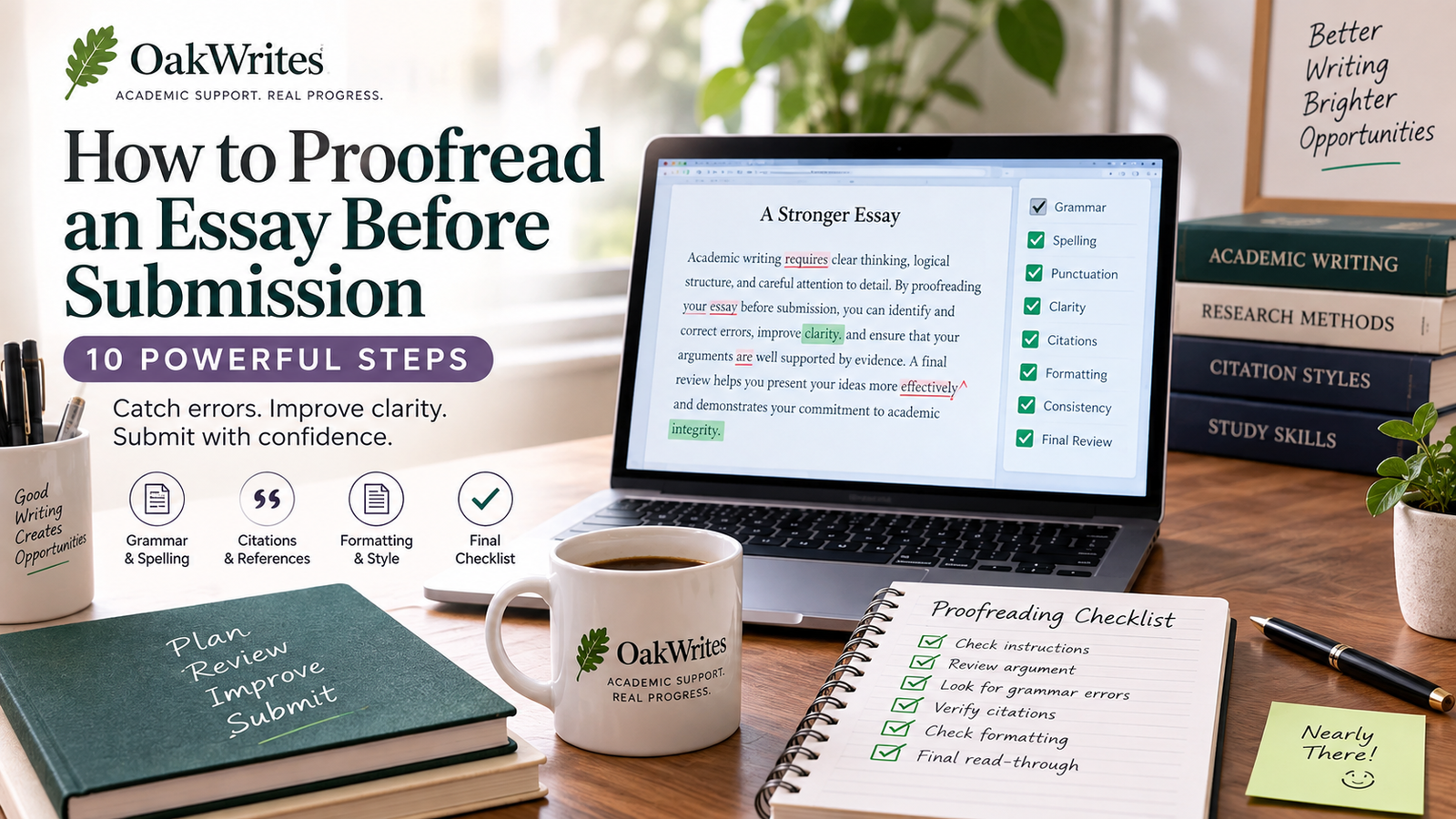
Essay Proofreading Checklist: 25 Things to Check Before Submission
Use this checklist as your final review. Mark each item only after you have actively checked it.
- I answered the exact assignment question.
- I followed all assignment instructions.
- My essay is within the required word count.
- My thesis clearly communicates the central argument.
- Each paragraph contributes to the overall argument.
- Each body paragraph has a clear main point.
- Evidence is relevant to the claims being made.
- Evidence is explained rather than simply inserted.
- Transitions make the relationship between ideas clear.
- Sentences are complete and understandable.
- Subject-verb agreement is correct.
- Verb tense is consistent and appropriate.
- Punctuation has been checked.
- Spelling has been checked manually as well as electronically.
- Word choice is precise and appropriate for academic writing.
- Repeated or unnecessary wording has been removed.
- All required quotations and paraphrases are cited.
- In-text citations follow the required style.
- The reference list follows the required style.
- Sources cited in the paper are represented in the reference list as required.
- Formatting matches the assignment requirements.
- Headings, page numbers, and other document elements are correct.
- The introduction and conclusion are consistent with the essay's argument.
- The final document has been read from beginning to end.
- The correct final file is ready for submission.
Should You Proofread on Screen or on Paper?
Both approaches can be useful. Reading on screen makes it convenient to search for repeated terms, use accessibility tools, and check formatting. Printing the document can sometimes make errors easier to notice because the physical format changes how you encounter the text.
If printing is not practical, change your viewing conditions. Increase or decrease the zoom, adjust the window size, or use a different device when possible. You can also read the essay aloud to slow down your reading and make awkward sentences more noticeable.
The important point is not that one method is universally superior. What matters is creating enough distance from your normal drafting process to examine the final text carefully.
Should You Use a Grammar Checker?
Grammar-checking software can be useful during proofreading, particularly for identifying possible spelling, punctuation, grammar, and style problems. However, automated suggestions should be treated as recommendations rather than automatic corrections.
A tool may misunderstand the intended meaning of a sentence or suggest a change that is inappropriate for the context. Always read the sentence yourself and decide whether the suggested correction actually improves the writing.
Common Essay Proofreading Mistakes to Avoid
Proofreading Immediately After Writing
When you have just finished writing, you already know what you intended to say. That familiarity can make it easier to overlook missing words, repeated phrases, or awkward sentences. If your schedule allows, create some separation between drafting and proofreading.
Trying to Fix Everything in One Pass
Grammar, argument, citations, formatting, and spelling require different kinds of attention. Using focused passes can make errors easier to identify.
Trusting Spellcheck Completely
Automated tools cannot reliably understand every context. A correctly spelled word can still be the wrong word for a sentence.
Ignoring the Reference List
Students sometimes spend considerable time checking the essay itself and then rush through the references. The reference list deserves its own careful review.
Changing the Meaning During Proofreading
Proofreading should improve accuracy and presentation without unintentionally changing the writer's intended meaning. If a sentence requires a substantial change to its argument or content, that is generally an editing task rather than a simple proofreading correction.
Forgetting the Submission Requirements
The final check should include the actual submission instructions. File type, naming requirements, word count, required sections, and submission location can all matter.
How to Proofread an Essay Faster Without Rushing
Effective proofreading does not necessarily mean reading the same document over and over. The key is to make each review purposeful.
- Start with the highest-risk issues. Check assignment requirements, thesis, citations, and major clarity problems before minor punctuation.
- Use a checklist. A checklist prevents you from repeatedly checking the same items while forgetting others.
- Separate content review from language review. First confirm that the argument works; then concentrate on sentence-level accuracy.
- Search for recurring errors. If you notice one repeated problem, search the document for similar instances.
- Reserve time for the final file. Do not make your proofreading deadline the same as your submission deadline.
If you need a structured workflow for getting an academic document ready, you can also review how OakWrites works.
When Should You Consider Professional Proofreading?
Some writers can complete a thorough final review independently, while others may want another person to examine the document after they have completed their own revisions.
Professional proofreading can be particularly useful when a document is important, time is limited, or you have already reviewed the same paper several times and are no longer noticing small errors.
OakWrites provides professional academic and document support. Before ordering, review the available OakWrites pricing information and frequently asked questions to understand the service and process.
Need a Final Review of Your Essay?
If you have completed your essay but want an additional review before submission, OakWrites can provide professional writing and proofreading support.
Order NowFrequently Asked Questions About Proofreading an Essay
How do you proofread an essay?
To proofread an essay, review it systematically for grammar, spelling, punctuation, sentence clarity, consistency, citations, references, formatting, and compliance with the assignment instructions. Complete the larger revisions first, then use several focused proofreading passes.
When should you proofread an essay?
Proofread an essay after completing major revisions to the argument, organization, evidence, and structure. If possible, leave some time between drafting and proofreading so you can approach the final text with fresh attention.
What should I check when proofreading an essay?
Check the assignment requirements, thesis, paragraph clarity, grammar, punctuation, spelling, sentence structure, transitions, citations, reference list, formatting, headings, page numbers, and final submission requirements.
Is proofreading the same as editing?
No. Editing generally addresses content, organization, argument, clarity, and style, while proofreading is the final review for errors and consistency after larger revisions have been completed.
Can I use a grammar checker to proofread an essay?
Yes, a grammar checker can help identify possible spelling, grammar, punctuation, and style issues. However, automated suggestions should be reviewed manually because software may misunderstand context or recommend an unsuitable change.
How many times should I proofread an essay?
There is no universal number of proofreading passes that works for every essay. Instead, use several focused reviews covering requirements, argument, paragraphs, sentence-level language, citations, references, formatting, and the final document.
Key Takeaways
- Proofreading is the final quality check after major editing and revision.
- Start by checking the assignment instructions.
- Review the thesis and overall argument before focusing on individual errors.
- Check paragraphs for clarity, evidence, explanation, and logical flow.
- Review grammar, punctuation, spelling, and word choice systematically.
- Check every citation and the reference list carefully.
- Verify formatting against the actual assignment requirements.
- Use grammar-checking tools as support rather than as a replacement for human judgment.
- Complete a final read-through of the exact file you intend to submit.
- Use a checklist so that important details are not overlooked.
A strong proofreading process does not attempt to rewrite an essay at the last minute. Instead, it systematically verifies that the finished document is accurate, clear, consistent, properly formatted, and ready for submission.
Ready to Submit With Confidence?
If your essay is complete but you want professional proofreading or academic writing support before submission, explore OakWrites or place your order.
Sources and Further Reading
Need Help With Your Assignment?
Submit your instructions through the OakWrites Client Portal. We will review your request and provide a personalized quotation before asking for payment.
Start Your AssignmentRelated Articles