Editing vs. Proofreading: Key Differences and Benefits
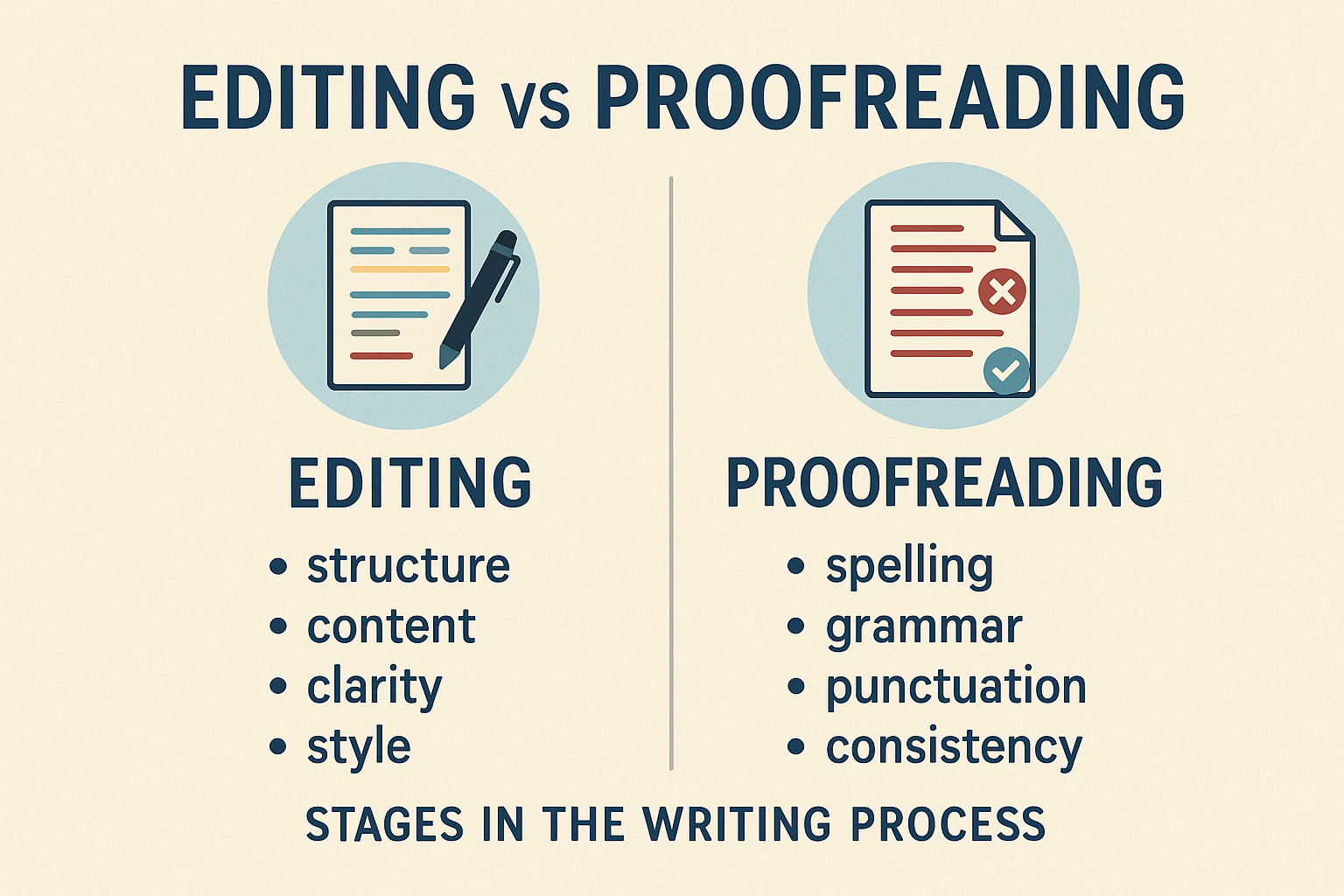
Understanding the distinctions between editing and proofreading is essential for producing polished and professional documents. While these terms are often used interchangeably, they represent different stages in the writing process, each serving a unique purpose to enhance the quality of your work.
What Is Editing?
Editing focuses on refining the content and structure of your document. This stage involves:
- Improving Clarity and Coherence: Ensuring that ideas are presented logically and flow smoothly.
- Enhancing Sentence Structure: Rewriting sentences for better readability and impact.
- Consistency in Style and Tone: Maintaining a uniform voice appropriate for the intended audience.
- Correcting Grammar and Punctuation: Addressing errors to ensure grammatical accuracy.
- Ensuring Consistency: Standardizing elements like formatting, terminology, and citation styles.
For example, an editor might revise a sentence like “The data was collected and analyzed by the team” to “The team collected and analyzed the data,” improving clarity and active voice usage.
What Is Proofreading?
Proofreading is the final step before publication, focusing on identifying and correcting surface-level errors. This includes:
- Spelling Mistakes: Correcting typographical errors.
- Punctuation Errors: Ensuring proper use of commas, periods, and other punctuation marks.
- Formatting Inconsistencies: Checking for uniformity in headings, fonts, and spacing.
- Typographical Errors: Identifying and correcting any typographical mistakes that may have been overlooked during editing.
For instance, proofreading would correct “The quick brown fox jumps over the lazy dog” to “The quick brown fox jumps over the lazy dog.” by fixing the missing period at the end.
Key Differences Between Editing and Proofreading
| Aspect | Editing | Proofreading |
|---|---|---|
| Focus | Content, structure, clarity, and style | Surface-level errors like spelling, grammar, and formatting |
| Timing | Occurs after drafting, before proofreading | Occurs after editing, as the final step before publication |
| Depth of Intervention | Involves substantial revisions, including rephrasing sentences and reorganizing paragraphs | Involves minor corrections without altering the document’s content or structure |
| Purpose | Enhances the overall quality and readability of the document | Ensures the document is error-free and ready for publication |
When to Use Editing and Proofreading
Both editing and proofreading are crucial for producing high-quality documents. Editing is appropriate when:
- The document requires significant revisions to improve clarity, structure, or style.
- There are inconsistencies in tone, voice, or formatting that need to be addressed.
- Complex sentences or paragraphs need to be simplified for better understanding.
Proofreading is necessary when:
- The document is complete, and only minor errors remain.
- The focus is on catching typographical, grammatical, or formatting mistakes.
- The document is ready for final submission or publication.
Conclusion
In summary, editing and proofreading serve distinct yet complementary roles in the writing process. Editing refines the content and structure, enhancing clarity and coherence, while proofreading ensures the document is free from surface-level errors. Both are essential for producing professional and polished work.
For assistance with editing and proofreading, consider exploring OakWrites’ services to ensure your documents meet the highest standards of quality.
Need Help With Your Assignment?
Submit your instructions through the OakWrites Client Portal. We will review your request and provide a personalized quotation before asking for payment.
Start Your AssignmentRelated Articles