Essay Prompt Analysis: 7 Powerful Steps for a Stronger Essay
Learn how essay prompt analysis helps you identify the task, topic, scope, evidence, and thesis before drafting. Includes examples, a verb table, and checklist.

Learn how essay prompt analysis helps you identify the task, topic, scope, evidence, and thesis before drafting. Includes examples, a verb table, and checklist.

Use these essay thesis statement tips to answer your prompt, develop a focused claim, connect evidence to your main point, and revise your thesis as your essay takes shape.

Use these seven essay writing tips for timed exams to interpret prompts, plan a focused argument, manage your time, and review your answer before submission.

Learn what the Uncategorized category in WordPress does, why posts land there, and how to rename it, change the default, reorganize older posts, and review its archive safely.
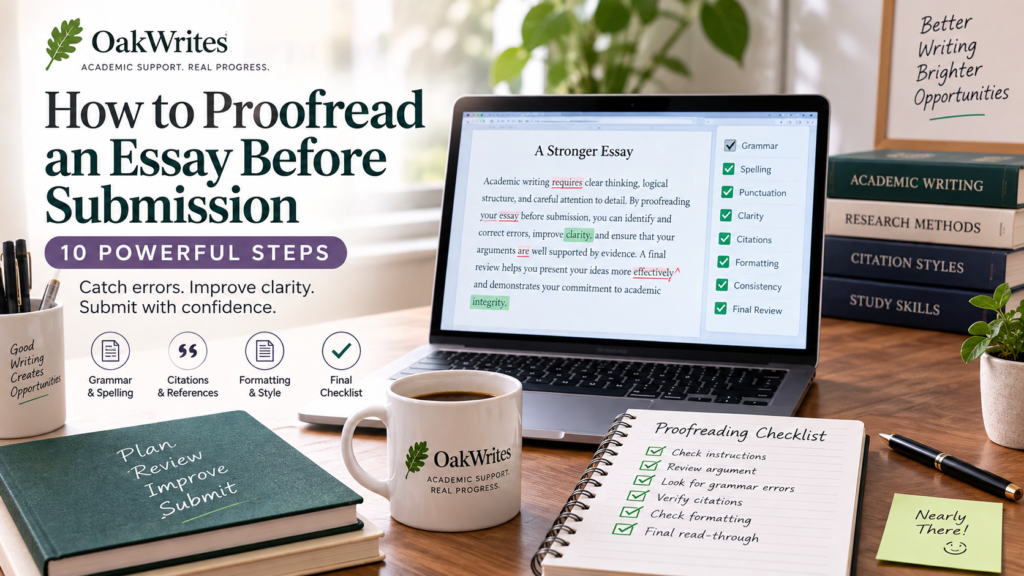
How to Proofread an Essay Before Submission: 10 Powerful Steps How to Proofread an Essay Before Submission: 10 Powerful Steps How Do You Proofread an Essay? To proofread an essay, review it systematically for grammar, spelling, punctuation, sentence clarity, consistency, citations, references, formatting, and compliance with the assignment instructions. The most effective approach is to complete the larger revisions first and then proofread in several focused passes rather than trying to find every mistake at once. Submitting an essay is more than finishing the final paragraph and clicking the upload button. A paper can contain a strong argument and useful evidence but still lose quality because of avoidable grammar errors, inconsistent formatting, missing citations, unclear sentences, or instructions that were overlooked. That is why learning how to proofread an essay is an important academic writing skill. A structured proofreading process gives you a final opportunity to catch problems before your instructor, professor, or evaluator reads the paper. This guide explains exactly what to check, when to proofread, which mistakes deserve the most attention, and how to use a final essay proofreading checklist before submission. Table of Contents What Does It Mean to Proofread an Essay? Editing vs. Proofreading: What Is the Difference? How to Proofread an Essay: 10 Steps 1. Recheck the Assignment Instructions 2. Check the Thesis and Overall Argument 3. Check Every Paragraph for Clarity and Flow 4. Check Sentence Structure and Academic Clarity 5. Check Grammar and Punctuation 6. Check Spelling and Word Choice 7. Check Your Citations 8. Check the Reference List 9. Check Formatting and Presentation 10. Complete a Final Read-Through Essay Proofreading Checklist Should You Proofread on Screen or on Paper? Should You Use a Grammar Checker? Common Essay Proofreading Mistakes When Should You Consider Professional Proofreading? Frequently Asked Questions Key Takeaways What Does It Mean to Proofread an Essay? Proofreading an essay means conducting a final, detailed review of an already-developed piece of writing to identify and correct errors. The review commonly focuses on spelling, grammar, punctuation, sentence construction, word choice, consistency, formatting, citations, references, and other presentation details. Proofreading is different from writing or major revision. At this stage, your central argument should already be developed. You are checking whether the finished document communicates that argument accurately and professionally. Important distinction: Proofreading should normally come after substantial editing. If your thesis, evidence, organization, or paragraph structure still needs major changes, revise those areas before completing the final proofreading pass. Editing vs. Proofreading: What Is the Difference? Editing and proofreading are related but serve different purposes. Editing can involve substantial changes to the content and organization of a document, while proofreading focuses primarily on correcting remaining errors and inconsistencies. Editing Proofreading Examines argument and organization. Checks the final text for errors. May involve restructuring paragraphs. Checks paragraph-level consistency and clarity. Can involve substantial rewriting. Usually involves smaller corrections. Evaluates whether ideas are developed effectively. Checks grammar, spelling, punctuation, formatting, and consistency. For a broader explanation of the distinction, see OakWrites’ guide to academic editing and proofreading services. How to Proofread an Essay: 10 Steps The best way to proofread an essay is to use a repeatable process. Instead of reading the paper repeatedly without a clear purpose, assign a specific task to each proofreading pass. 1. Recheck the Assignment Instructions Before correcting individual sentences, return to the original assignment instructions. Confirm the required topic, question, word count, document type, formatting requirements, citation style, number or type of sources, and submission requirements. This first step matters because an essay can be grammatically polished and still fail to meet the assignment requirements. Have you answered the exact question? Is the essay within the required word count? Have you followed the required citation style? Did you include all required sections? Have you followed the required formatting? Are all required sources or types of evidence included? 2. Check the Thesis and Overall Argument Read your introduction and thesis statement separately from the rest of the paper. Ask whether the thesis clearly communicates the main position or controlling idea of the essay. Then read the conclusion. Does it return to the central argument without introducing an unrelated new idea? Finally, look at each major section and ask whether it contributes to the thesis. Proofreading is not only about commas and spelling; a final review can also reveal places where the finished paper no longer matches its original argument after revisions. If the thesis still feels unclear, consider revising it before completing your final proofreading pass. 3. Check Every Paragraph for Clarity and Flow Read each paragraph individually. Identify the main point and determine whether the supporting sentences actually develop that point. Pay particular attention to topic sentences, evidence, explanations, and transitions. A paragraph may contain grammatically correct sentences but still feel difficult to follow if the ideas are presented in an unclear order. Does the paragraph have a clear purpose? Does the topic sentence introduce the main idea? Does the evidence support the paragraph’s point? Have you explained the relevance of the evidence? Does the paragraph connect logically to the next one? 4. Check Sentence Structure and Academic Clarity Read each sentence carefully rather than relying only on the overall meaning of the paragraph. Look for sentences that are unnecessarily long, incomplete, repetitive, vague, or difficult to understand. Watch for common problems such as sentence fragments, run-on sentences, awkward constructions, unnecessary words, unclear pronouns, and inconsistent verb tense. Useful technique: Read difficult sentences aloud. If you need to reread a sentence to understand what it means, it may need revision. 5. Check Grammar and Punctuation Now make a focused grammar and punctuation pass. Looking for one category of error at a time can be more effective than attempting to identify every issue simultaneously. Check areas such as: Subject-verb agreement Verb tense consistency Pronoun agreement Comma usage Apostrophes Quotation marks Colons and semicolons Capitalization Sentence boundaries Academic writing also benefits from consistency. For example, do not switch unnecessarily between past and present tense when discussing the same material.
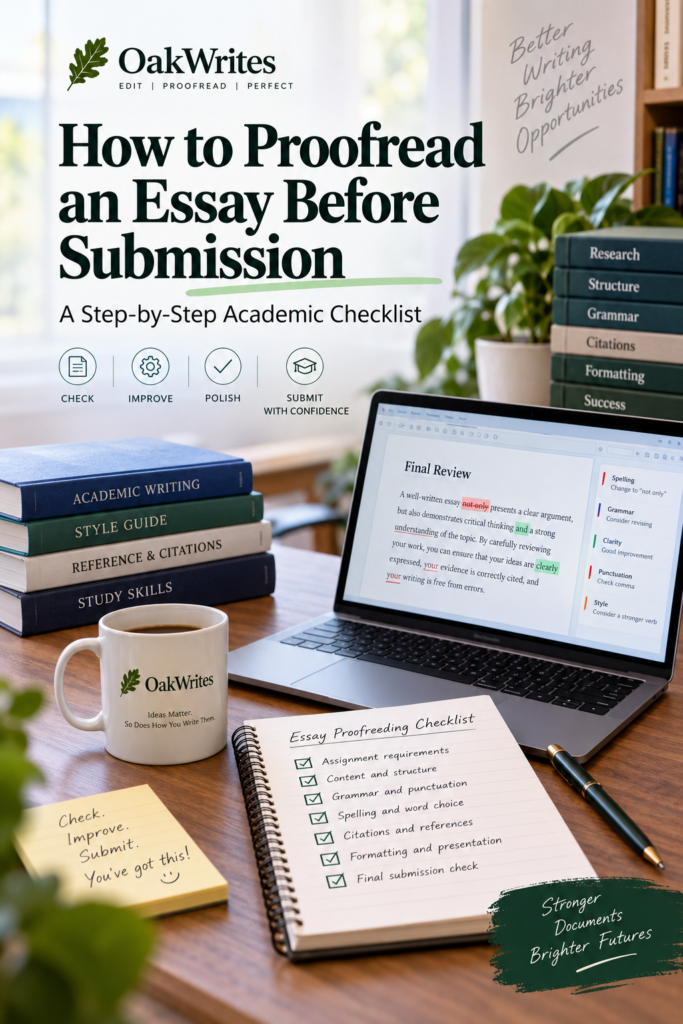
How to Proofread an Essay Before Submission: Complete Checklist | OakWrites A structured proofreading process can help you identify errors before submitting an academic essay. Essay Editing & Proofreading How to Proofread an Essay Before Submission: A Step-by-Step Academic Checklist You have finished your essay, checked the word count, and perhaps read it several times. It may feel ready to submit. But proofreading is more than reading an essay once and looking for spelling mistakes. How Do You Proofread an Essay? To proofread an essay effectively, first make sure the content and structure are finalized, then check the document systematically for grammar, spelling, punctuation, consistency, citations, formatting, and submission requirements. Working through these areas separately makes it easier to catch errors that are easy to overlook when you simply reread the paper from beginning to end. The most important rule is simple: edit first, proofread last. Table of Contents What Does It Mean to Proofread an Essay? Editing vs. Proofreading How to Proofread an Essay: 10 Steps 25-Point Essay Proofreading Checklist Screen or Paper: Which Is Better? Should You Use Grammar Checkers? Common Proofreading Mistakes When Should You Get Professional Proofreading? What If Your Essay Needs More Than Proofreading? The 5-Minute Final Proofreading Check Frequently Asked Questions Key Takeaways What Does It Mean to Proofread an Essay? Proofreading is the final quality check performed after the essay’s content, argument, organization, and wording have been substantially finalized. During proofreading, you look for issues such as: Spelling mistakes Grammar errors Punctuation problems Missing or repeated words Incorrect capitalization Inconsistent terminology Formatting inconsistencies Citation and reference-list problems Heading and page-number errors Other small mistakes that remain in the final document Proofreading is therefore different from rewriting an essay. If your thesis is unclear, your paragraphs are poorly organized, or your argument needs additional evidence, you may need revision or editing before proofreading. Editing vs. Proofreading: What Is the Difference? The easiest way to remember the difference is: Editing improves the writing. Proofreading checks the finished writing for remaining errors. Area Editing Proofreading Main purpose Improve clarity, flow, organization, and expression Find remaining surface-level errors Timing Before final proofreading Final stage Structure May identify structural problems Usually leaves structure unchanged Sentences May improve awkward wording Corrects errors and inconsistencies Grammar Corrects and may improve usage Checks remaining errors Citations May identify citation problems Checks consistency and formatting Best for Drafts needing improvement Finalized drafts A useful workflow is: Revise → Edit → Proofread → Final submission check How to Proofread an Essay: 10 Steps 1. Recheck the Assignment Instructions Before checking individual sentences, return to the assignment instructions. A polished essay can still fail to meet an important requirement, so check: Did you answer every part of the question? Did you follow the required essay structure? Did you meet the word-count requirements? Did you use the required sources? Did you follow the required citation style? Did you address every element of the rubric? Did you follow formatting instructions? Did you submit the required file type? If the assignment includes a rubric, use it as a final checklist rather than relying on memory. 2. Check the Thesis and Overall Argument Proofreading should happen after major editing, but perform one final high-level check before focusing on individual sentences. Read: Your introduction The thesis statement The first sentence of each body paragraph Your conclusion Then ask: Does the essay actually make the argument promised in the introduction? If the introduction promises an evaluation of three factors but the body discusses unrelated issues, you have an organization problem rather than a simple proofreading problem. 3. Check Every Paragraph for Clarity and Flow For each paragraph, ask: Does it have one clear main idea? Does the topic sentence match the paragraph? Is the evidence relevant? Is the explanation clear? Does the paragraph connect to the previous one? Does it contribute to the thesis? Have I repeated the same point elsewhere? Read the final sentence of one paragraph and the first sentence of the next. If the transition does not make sense, edit the connection before moving on to proofreading. 4. Check Sentence Structure and Academic Clarity Look for: Extremely long sentences Sentence fragments Unclear pronouns Repeated words Vague expressions Unnecessary filler Awkward constructions Inconsistent verb tense Subject-verb agreement problems Poor transitions Example Less precise: The results of the study were very important and showed a lot of different things that were related to student performance. More precise: The study results identified several factors associated with student performance. Do not replace every sentence with complicated vocabulary simply to make it sound academic. Strong academic writing prioritizes precision and clarity. 5. Check Grammar and Punctuation Perform a dedicated grammar pass rather than trying to check everything simultaneously. Subject-Verb Agreement Incorrect: The results shows a difference. Correct: The results show a difference. Verb Tense Check whether the tense remains appropriate and consistent throughout the relevant discussion. Commas Look for: Missing commas Unnecessary commas Comma splices Missing punctuation after introductory phrases where required Sentence Boundaries Look for: Run-on sentences Comma splices Fragments Missing periods Capitalization Check proper nouns, names, institutions, abbreviations, headings, and other terms according to the required style. 6. Check Spelling and Word Choice Spell-checking software can catch many obvious errors, but do not depend on it completely. Some errors involve correctly spelled words used incorrectly: affect / effect principle / principal its / it’s their / there / they’re than / then complement / compliment Also check discipline-specific terminology. A specialized academic term may be unfamiliar to general-purpose software, so review software suggestions before accepting them. If you use British or American English, maintain the appropriate form consistently unless your institution specifies otherwise. 7. Check Your Citations During the final citation pass, check that: Every borrowed idea is appropriately cited. In-text citations follow the required style. Author names are spelled consistently. Publication years are correct. Direct quotations have the required citation information. Citations are placed where the reader can identify the supported claim. The same citation style is used
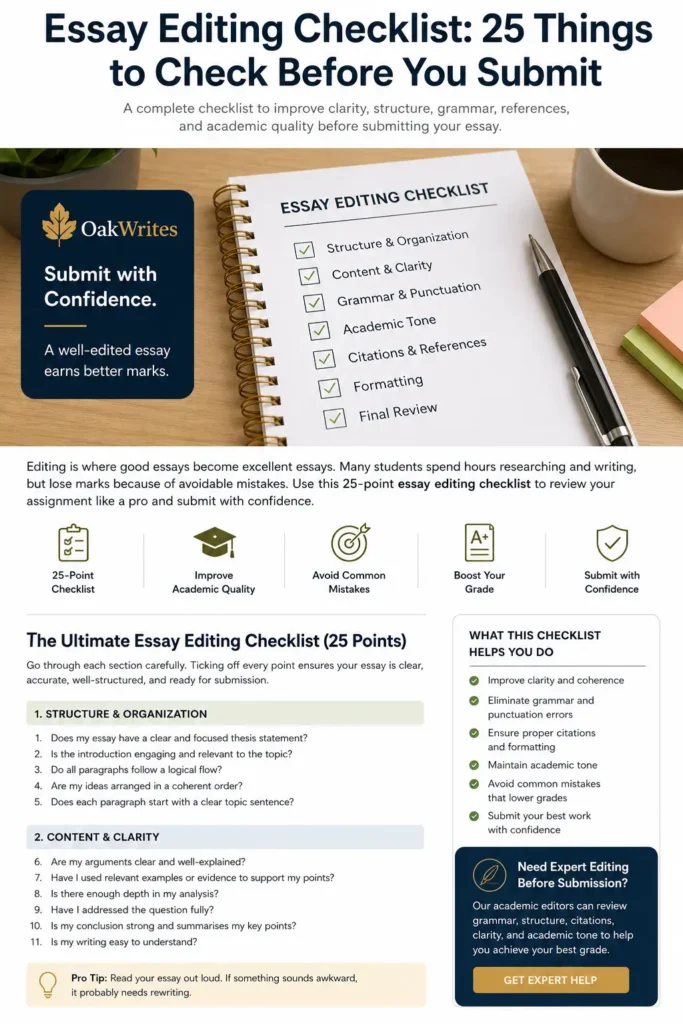
OakWrites Student Resource Essay Editing Checklist: 25 Things to Check Before You Submit Use this practical, step-by-step checklist to strengthen your argument, improve clarity, correct citations, polish your academic tone, and submit your essay with confidence. Updated July 2026 Approx. 12-minute read Essay Editing You have completed the research, written the final paragraph, and checked the word count. At this point, clicking Submit may feel like the only task left. However, the final editing stage is where many avoidable problems can still be found and corrected. One of the most common issues we see while reviewing academic papers is that strong ideas are weakened by unclear thesis statements, uneven paragraph structure, unsupported claims, inconsistent citations, or rushed proofreading. These problems do not always require a complete rewrite. In many cases, a systematic final review can make the essay clearer, more persuasive, and easier to assess. Quick answer: Before submitting an essay, check that you answered the assignment question, presented a clear thesis, organized paragraphs logically, supported claims with evidence, used an appropriate academic tone, cited every borrowed idea, followed the required format, and completed a final grammar and spelling review. This 25-point essay editing checklist moves from large issues, such as argument and organization, to smaller details, such as punctuation and formatting. Work through it in order rather than correcting random sentences as you notice them. Why Essay Editing Matters Writing and editing are related, but they are not the same task. Writing helps you develop and express ideas. Editing tests whether those ideas are clear, relevant, logically organized, adequately supported, and presented in the required academic style. A final review can help you identify missing evidence, remove repetition, improve transitions, correct referencing errors, and make your argument easier to follow. Proofreading should come last because correcting commas is less useful when a paragraph may still need to be moved, shortened, or rewritten. Stage Main focus Typical questions Revising Ideas, argument, evidence, and organization Did I answer the question? Is my argument convincing? Editing Clarity, academic tone, flow, and sentence quality Is this precise? Does each sentence contribute? Proofreading Grammar, spelling, punctuation, and formatting Are there errors or inconsistencies in the final draft? Assignment and Argument Checks 1Have you answered the exact question? Read the assignment prompt again and identify every instruction word, such as analyze, compare, evaluate, or discuss. Your essay should perform the requested task, not merely provide background information about the topic. Check: Can you point to a section that addresses every part of the prompt? 2Is your thesis specific and arguable? Your thesis should state the position or central claim your essay will defend. Avoid a thesis that only announces the subject. Weak: This essay discusses social media and mental health. Stronger: Although social media can support connection, frequent comparison-driven use can intensify anxiety among university students. 3Does every major point support the thesis? Remove interesting details that do not help prove your main argument. A paragraph may be well written and still be unnecessary if it does not advance the essay’s purpose. 4Have you addressed reasonable counterarguments? For argumentative or analytical essays, briefly acknowledging an opposing view can make your position more credible. Explain why your interpretation remains stronger rather than ignoring alternatives. 5Is the scope manageable? Check whether your essay attempts to prove too much within the available word count. A focused argument supported in depth is usually stronger than several broad claims explained superficially. Editor tip: Create a reverse outline Write one short sentence beside each paragraph explaining its purpose. If two paragraphs perform the same job, combine or distinguish them. If a paragraph has no clear purpose, revise or remove it. Structure and Organization Checks 6Does the introduction establish direction? Your introduction should orient the reader, define the issue when necessary, and lead naturally to the thesis. Avoid beginning with an overly broad statement that could introduce almost any essay. 7Does each paragraph have one central idea? A paragraph should not shift between unrelated claims. Its topic sentence, evidence, analysis, and closing connection should work together to develop one main point. 8Are paragraphs arranged logically? Arrange ideas according to a clear principle, such as importance, chronology, cause and effect, comparison, or stages in an argument. The strongest order is the one that makes the reasoning easiest to follow. 9Do transitions show relationships? Use transitions to explain whether the next idea adds evidence, introduces contrast, presents a consequence, or gives an example. Avoid adding transition words mechanically when the logical connection is unclear. 10Does the conclusion provide closure? The conclusion should synthesize the main argument, reinforce its significance, and leave the reader with a clear final understanding. Do not introduce major new evidence in the final paragraph. Evidence and Analysis Checks 11Is every important claim supported? Identify statements that a reader could reasonably question. Support factual claims with credible evidence and make clear when a statement is your interpretation. 12Are your sources appropriate? Check whether the assignment requires peer-reviewed research, recent sources, primary evidence, course materials, or a minimum number of references. Replace weak sources when more authoritative evidence is available. 13Have you analyzed rather than summarized? After presenting evidence, explain what it demonstrates, why it matters, and how it supports your thesis. A quotation or statistic should not be expected to explain itself. Useful pattern: Claim → Evidence → Interpretation → Link to the argument. 14Are quotations integrated smoothly? Introduce quoted material, provide the required citation, and explain its relevance. Avoid dropping a quotation into a paragraph without grammatical or analytical connection. 15Have you checked names, dates, and figures? Verify all factual details against the original sources. A correctly formatted citation cannot compensate for an inaccurate statistic, date, spelling, or interpretation. Need Help Before Submission? OakWrites can review grammar, structure, citations, formatting, clarity, and academic tone so you can submit a more polished final draft. Order Editing View Pricing Clarity and Academic Style Checks 16Is your language precise? Replace vague words such as things, good, bad, or a lot with language

You spent hours researching. You met the deadline. You even checked the word count twice. So why did the grade come back lower than you expected?
In most cases, it isn’t the ideas that let students down — it’s a handful of small, repeated mistakes that markers notice instantly. The good news: every one of them is fixable, and most take only minutes once you know what to look for.
Here are the ten mistakes we see most often in the essays submitted to OakWrites for editing, and exactly how to correct them before your lecturer ever sees them.
1. A vague or missing thesis statement
Your thesis is the single sentence that tells the reader what your essay argues. If a marker finishes your introduction and still can’t say what position you’re taking, marks are already slipping away.
The fix: After writing your introduction, underline your thesis. If you can’t find a sentence to underline — or if it just describes the topic rather than making a claim — rewrite it. “This essay discusses social media and mental health” is a topic. “Social media use increases anxiety in teenagers primarily through disrupted sleep, not online comparison” is a thesis.
2. Paragraphs without a clear point
Each paragraph should make one point, state it early, support it with evidence, and connect it back to your thesis. Paragraphs that drift between two or three ideas force the marker to do your organizing for you — and they rarely reward you for it.
The fix: Read only the first sentence of every paragraph. Together, they should read like a summary of your whole argument. If they don’t, your topic sentences need work.
3. Dropping in quotes without explaining them
A quotation is evidence, not an argument. When a quote appears and the paragraph simply moves on, the marker sees unprocessed source material — and it reads as filler.
The fix: Follow every quotation with at least one sentence in your own words explaining what it shows and why it matters to your point. If you can’t explain it, cut it.
4. Formatting and referencing errors
APA, MLA, Harvard and Chicago each have precise rules for citations, reference lists, headings and even spacing — and referencing errors are among the easiest marks to lose, because they’re the easiest for a marker to spot.
The fix: Confirm which style your course requires before you start, and format citations as you write rather than “fixing them later.” Later has a habit of never arriving at 2 a.m. before the deadline. If referencing isn’t your strength, this is one of the highest-value things to have professionally checked — our editors correct APA, MLA and Harvard formatting on every order.
5. An introduction that says nothing
“Since the beginning of time, humans have communicated.” Openings like this tell the marker nothing and waste your most valuable real estate — the first impression.
The fix: Open with something specific: a statistic, a scholarly debate, a concrete example, or a direct statement of the problem. Then narrow to your thesis. Aim for an introduction that could only belong to your essay.
6. Repetition dressed up as length
When an essay restates the same point in different words to reach the word count, markers notice immediately. Padding doesn’t just fail to add marks — it dilutes your strongest material.
The fix: If you’re short of the word count, don’t repeat — deepen. Add a counterargument and respond to it, apply your point to a second example, or address a limitation of your evidence. All three earn marks; repetition earns none.
7. Informal language in academic writing
Contractions (“don’t,” “can’t”), casual phrasing (“a lot of,” “pretty much”), and conversational asides all signal to a marker that the register is wrong for academic work.
The fix: Do a dedicated pass just for tone. Expand contractions, replace vague quantifiers with precise ones, and remove anything you’d say to a friend but not in a presentation.
8. Sentences that try to do too much
Long sentences aren’t automatically bad — unclear ones are. When a sentence carries three ideas, two subordinate clauses and a quotation, the reader loses the thread, and your point loses its force.
The fix: Read your work aloud. Anywhere you run out of breath or stumble, split the sentence. One idea per sentence is a rule you can break — but only once you can follow it.
9. A conclusion that just repeats the introduction
Copy-pasting your introduction with the words rearranged is the most common conclusion mistake there is. Markers read hundreds of essays; they recognize it instantly.
The fix: A strong conclusion answers “so what?” Restate your thesis briefly, then show its wider significance: what it means for the field, what remains unresolved, or what should happen next. End on your idea, not on a summary.
10. Submitting the first draft
This is the mistake behind most of the others. Writing and editing are different skills, and no one — not students, not professional writers — produces polished work in a single pass. An essay that has never been revised almost always reads like it.
The fix: Finish your draft at least a day before the deadline, step away, then edit in separate passes: one for structure and argument, one for clarity and flow, one for grammar and formatting. Fresh eyes catch what tired eyes cannot.
When a second pair of eyes makes the difference
You can catch many of these mistakes yourself with the checks above. But there’s a reason even professional authors have editors: after hours on the same document, your brain reads what you meant to write, not what’s on the page.
That’s exactly what our Editing & Proofreading service is for. Starting at just $4 per page, an OakWrites editor will correct your grammar and punctuation, tighten clarity and flow, fix your APA, MLA or Harvard formatting, and flag structural issues — while preserving your voice and your ideas. You submit your draft through your secure Client Portal, receive a clear quotation before any payment, and get your polished document back with your deadline in mind.
Place your order today, or view our pricing to see starting rates for all our services. Your ideas deserve to be read at their best.