Essay Prompt Analysis: 7 Powerful Steps for a Stronger Essay
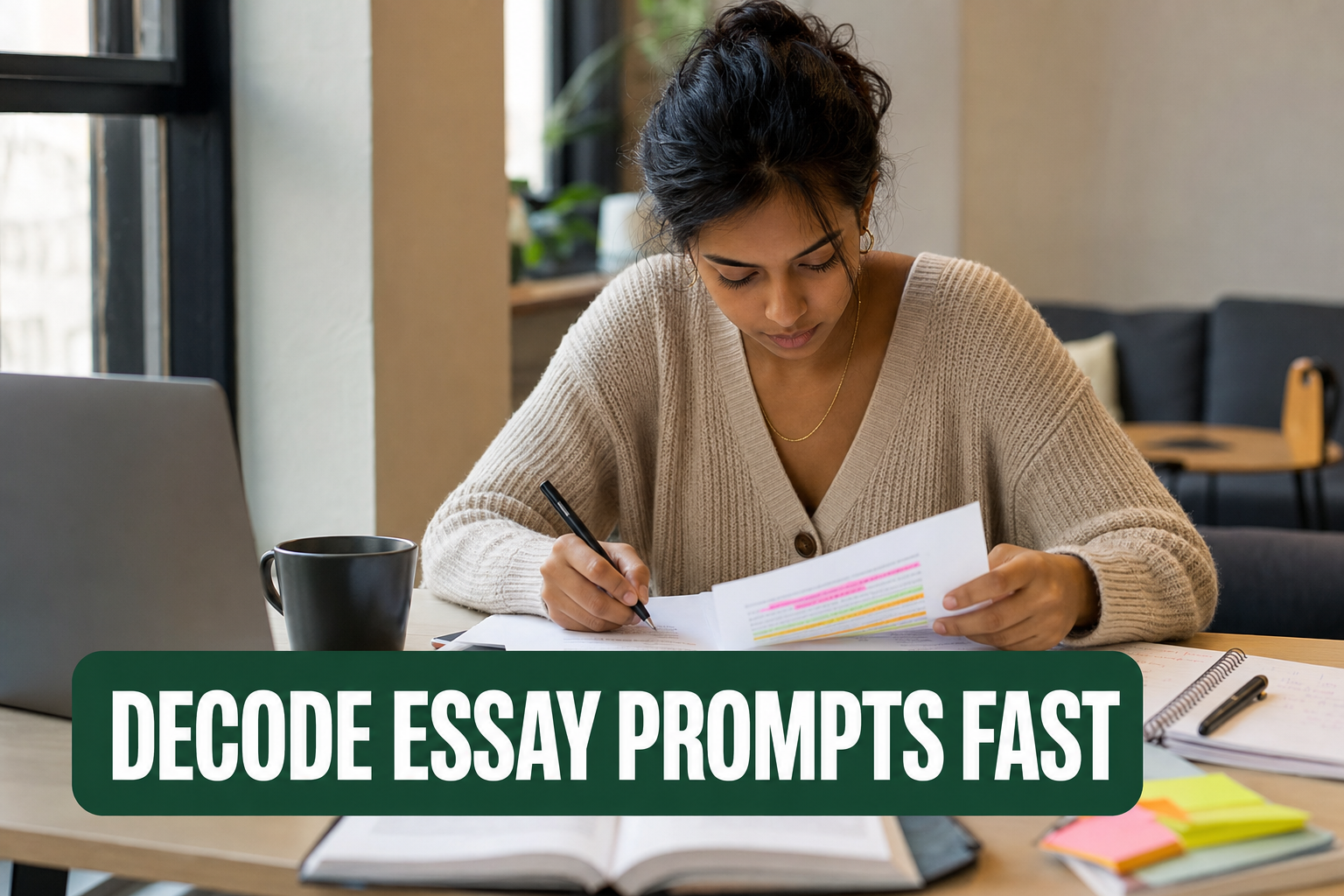

Essay prompt analysis means breaking an assignment question into its task, topic, limits, evidence requirements, format rules, and grading expectations before you draft. It helps you answer the actual question, choose relevant evidence, avoid off-topic paragraphs, and build a thesis that matches what your instructor is asking for.
Many weak essays struggle because the writer answers a related topic instead of the assigned task. A prompt that asks you to evaluate a policy is different from one that asks you to describe it. Essay prompt analysis turns those details into a writing plan.
This guide shows you how to identify the action verb, define the topic, spot hidden requirements, turn the prompt into a working question, and test your thesis before drafting. If you later need help polishing structure, clarity, citations, or formatting, OakWrites document-support services can help you strengthen the draft without replacing your own academic judgment.
What Is Essay Prompt Analysis?
Essay prompt analysis is the process of studying an assignment prompt before writing so you understand the exact task, scope, evidence, audience, and expected response. Instead of treating the prompt as a topic suggestion, you treat it as a set of instructions that controls your thesis, outline, evidence, and revision priorities.
University writing centers often recommend identifying action words such as analyze, compare, discuss, explain, propose, trace, or research because those verbs reveal what kind of intellectual work the essay should perform.
A good prompt analysis answers six questions:
- Task: What action must the essay perform?
- Topic: What subject, text, issue, case, or problem must be addressed?
- Scope: What limits, time period, population, chapter, theory, or course concept applies?
- Evidence: What sources, examples, data, readings, or citations are required?
- Format: What length, citation style, structure, or file requirement is stated?
- Evaluation: What will the instructor likely reward in the rubric?
Why Essay Prompt Analysis Matters
Essay prompt analysis matters because it prevents the most expensive drafting mistake: writing a polished essay that does not answer the question. When you understand the prompt early, you can plan a thesis that fits the assignment, select evidence that belongs, and avoid wasting paragraphs on background information that does not advance the task.
It also improves revision. If your draft feels unclear, return to the prompt and ask: Did every section answer the task verb? Did each body paragraph connect to the thesis? Did I use the required evidence? Did I meet the formatting rules?
7 Steps for Essay Prompt Analysis
1. Read the prompt twice before highlighting anything
Read the entire prompt once without marking it. Your goal is to understand the course context, subject, deliverable, and deadline. Then read it again and mark only the words that control your essay: task verbs, required sources, key concepts, limits, formatting instructions, and grading criteria.
2. Identify the main task verb
The task verb tells you what kind of thinking your essay must show. “Summarize the article” asks for a different response than “evaluate the article’s argument.” “Compare” means you should examine meaningful similarities and differences. “Analyze” means you should break the topic into parts and explain how those parts work together.
3. Separate the topic from the task
The topic is what the essay is about. The task is what you must do with that topic. Suppose the prompt says, “Analyze how social media affects political participation among first-time voters, using at least three course readings.” The topic is social media and first-time voters. The task is to analyze effects on political participation. The evidence requirement is at least three course readings.
4. Define the scope and limits
Most prompts include boundaries: a word count, time period, geographic area, theory, population, course unit, or required text. If the assignment asks you to discuss “two causes of urban housing insecurity since 2008,” do not try to cover every cause across all modern history. Scope tells you what belongs and what should be left out.
5. List the required evidence and citation rules
Before drafting, write down exactly what evidence the prompt requires. Does it ask for peer-reviewed sources, course readings, a case study, field notes, statistics, or a primary text? Does it require APA, MLA, Chicago, Harvard, or another format? If you know the evidence rules early, you can build them into your outline. OakWrites also has guides on how to cite a website, references versus bibliography, and how to cite multiple authors.
6. Turn the prompt into a working question
Once you know the task and topic, rewrite the prompt as a question you can answer. If the prompt says, “Evaluate the effectiveness of remote work policies in improving employee productivity,” your working question might be: “How effective are remote work policies at improving employee productivity, and what evidence supports that judgment?”
7. Build a thesis and outline that directly answer the prompt
Your thesis should answer the prompt’s main question using the required task verb. If the prompt asks you to compare two theories, make a comparative claim. If it asks you to propose a solution, identify the solution and why it is appropriate. Test your thesis with this sentence: “This essay answers the prompt by arguing that…” For more help, see OakWrites’ guide to essay thesis statement tips.
Common Prompt Verbs and What They Mean
Task verbs tell you what your essay should do. Use this table during essay prompt analysis to choose the right structure.
| Prompt Verb | What It Usually Requires | Essay Strategy |
|---|---|---|
| Analyze | Break a subject into parts and explain how those parts work or relate. | Use body paragraphs for key parts, patterns, causes, or effects. |
| Compare | Explain meaningful similarities and differences. | Organize by criteria rather than writing two separate mini-essays. |
| Evaluate | Judge value, effectiveness, strength, or weakness. | State criteria for judgment and support each criterion with evidence. |
| Argue | Make a debatable claim and defend it. | Use a clear thesis, evidence, analysis, and counterargument where appropriate. |
| Explain | Make a concept, process, or relationship understandable. | Use definitions, examples, causes, steps, or background in logical order. |
| Reflect | Connect experience, learning, and interpretation. | Use specific examples and explain what they reveal about your learning. |
| Propose | Recommend a solution, plan, or course of action. | Define the problem, present the proposal, justify it, and address limits. |
Worked Example: From Prompt to Thesis
Sample prompt: In a 1,200-word essay, evaluate whether online discussion boards improve student engagement in undergraduate courses. Use at least two scholarly sources and one example from class discussion. Follow APA style.
- Task verb: Evaluate. The essay must make a judgment, not just describe discussion boards.
- Topic: Online discussion boards and student engagement.
- Scope: Undergraduate courses.
- Evidence: At least two scholarly sources plus one class discussion example.
- Format: APA style.
Weak thesis: Online discussion boards are common in undergraduate courses and can affect student engagement.
Stronger thesis: Online discussion boards can improve undergraduate student engagement when instructors use clear prompts, require meaningful peer response, and connect online discussion to in-class learning; however, they are less effective when participation is treated as a simple completion task.
Common Mistakes to Avoid
Mistake 1: Writing about the topic instead of answering the task
A prompt about climate policy does not automatically ask for a history of climate change. A prompt about a novel does not automatically ask for plot summary. Always return to the task verb.
Mistake 2: Ignoring small instructions
Small instructions often affect grading. If the prompt asks for three scholarly sources, a draft with one source is incomplete even if the argument is interesting.
Mistake 3: Treating “discuss” as a vague invitation
Discuss usually means more than “say something about this topic.” It often requires explanation, analysis, examples, and a developed response. If the word feels unclear, look at the surrounding instructions or ask your instructor what kind of discussion is expected.
Mistake 4: Starting the introduction before understanding the assignment
Students often draft an introduction first because it feels like the beginning. In practice, the best first step is understanding the assignment. Once essay prompt analysis gives you a working thesis and outline, the introduction becomes easier to write. OakWrites’ guide to a research paper introduction can also help with formal academic openings.
Mistake 5: Forgetting to revisit the prompt during revision
Prompt analysis is not only a prewriting task. Use the prompt again after drafting. If a paragraph is interesting but does not answer the task, revise or remove it.
Essay Prompt Analysis Checklist
- I identified the main task verb.
- I separated the topic from the task.
- I marked the scope, limits, and required focus.
- I listed the required number and type of sources.
- I checked the citation style and formatting rules.
- I turned the prompt into a working question.
- I wrote a thesis that directly answers that question.
- I planned body paragraphs that match the prompt, not just the general topic.
- I checked whether the rubric adds expectations not fully explained in the prompt.
- I reread the prompt after drafting to confirm that every major section belongs.
If you have a draft but are unsure whether it fully answers the assignment, you can submit your assignment and draft to OakWrites for a personalized review request, or view OakWrites pricing before ordering.
Frequently Asked Questions
What is essay prompt analysis?
Essay prompt analysis is the process of breaking down an assignment question into the task, topic, scope, evidence requirements, formatting rules, and grading expectations before drafting.
How do I start analyzing an essay prompt?
Start by reading the prompt twice. Then underline the task verb, circle the topic, mark limits such as word count or source requirements, and rewrite the prompt as a question your thesis can answer.
What is the difference between a topic and a prompt?
A topic is the subject of the essay. A prompt is the full assignment instruction that tells you what to do with that topic.
Why do I keep losing points for not answering the prompt?
This usually happens when the essay gives background or summary but does not perform the required task. Check the prompt verb and make sure each paragraph performs that task explicitly.
Should my thesis use the same words as the prompt?
Your thesis can use key terms from the prompt if they are important, but it should not simply repeat the prompt. A strong thesis answers the prompt with a specific claim, reason, interpretation, or judgment.
Can OakWrites help me understand an essay prompt?
OakWrites can support students with document review, editing, proofreading, formatting, citation support, and assignment-related writing guidance. If your request is unusual, you can contact OakWrites before submitting an order.
Key Takeaways
- Essay prompt analysis should happen before drafting.
- The task verb is the strongest clue to what your essay must do.
- A prompt includes scope, evidence, format, and evaluation expectations.
- A strong thesis directly answers the working question created from the prompt.
- Rechecking the prompt during revision helps remove off-task paragraphs.
A strong essay begins with a clear understanding of the assignment. Identify the task, define the scope, plan the evidence, and build a thesis that answers the question directly. When your draft is ready for refinement, review how the OakWrites process works or use the OakWrites FAQ for common questions about orders, revisions, and document support.
Sources
- Harvard College Writing Center: Tips for Reading an Assignment Prompt
- University of Wisconsin–Madison Writing Center: Interpreting Writing Assignments from Your Courses
- George Mason University Writing Center: Understanding Your Instructor’s Prompt
- University of Nevada, Reno Writing & Speaking Center: Understanding Writing Prompts
- UMass Boston Writing Center: Understanding an Assignment
Need Help With Your Assignment?
Submit your instructions through the OakWrites Client Portal. We will review your request and provide a personalized quotation before asking for payment.
Start Your AssignmentRelated Articles