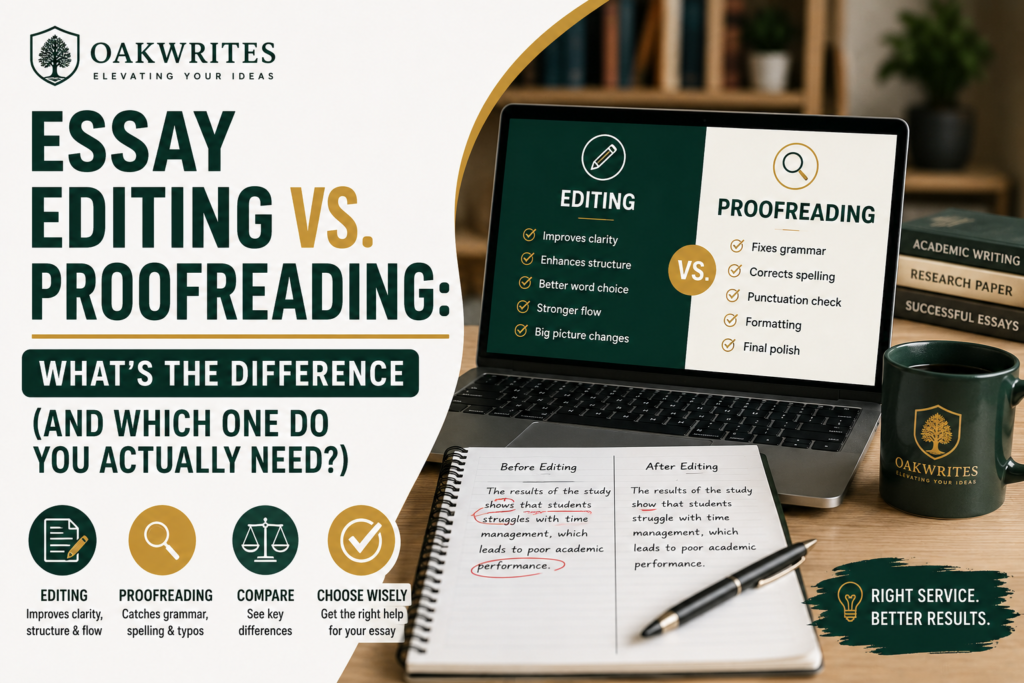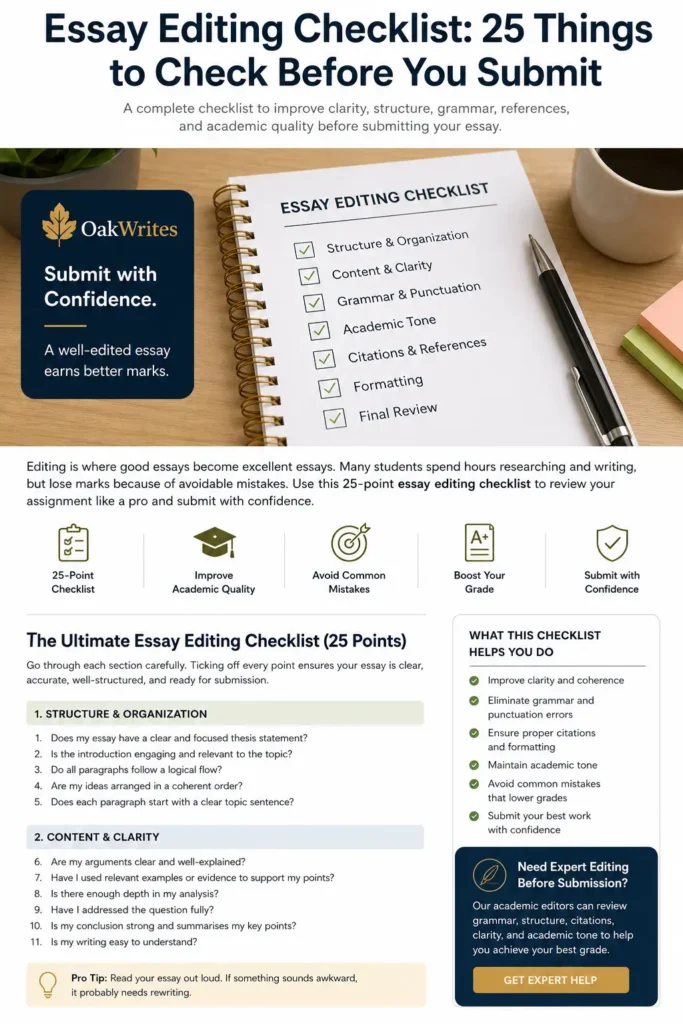
How to Proofread an Essay Before Submission: 10 Powerful Steps
How to Proofread an Essay Before Submission: 10 Powerful Steps How to Proofread an Essay Before Submission: 10 Powerful Steps How Do You Proofread an Essay? To proofread an essay, review it systematically for grammar, spelling, punctuation, sentence clarity, consistency, citations, references, formatting, and compliance with the assignment instructions. The most effective approach is to complete the larger revisions first and then proofread in several focused passes rather than trying to find every mistake at once. Submitting an essay is more than finishing the final paragraph and clicking the upload button. A paper can contain a strong argument and useful evidence but still lose quality because of avoidable grammar errors, inconsistent formatting, missing citations, unclear sentences, or instructions that were overlooked. That is why learning how to proofread an essay is an important academic writing skill. A structured proofreading process gives you a final opportunity to catch problems before your instructor, professor, or evaluator reads the paper. This guide explains exactly what to check, when to proofread, which mistakes deserve the most attention, and how to use a final essay proofreading checklist before submission. Table of Contents What Does It Mean to Proofread an Essay? Editing vs. Proofreading: What Is the Difference? How to Proofread an Essay: 10 Steps 1. Recheck the Assignment Instructions 2. Check the Thesis and Overall Argument 3. Check Every Paragraph for Clarity and Flow 4. Check Sentence Structure and Academic Clarity 5. Check Grammar and Punctuation 6. Check Spelling and Word Choice 7. Check Your Citations 8. Check the Reference List 9. Check Formatting and Presentation 10. Complete a Final Read-Through Essay Proofreading Checklist Should You Proofread on Screen or on Paper? Should You Use a Grammar Checker? Common Essay Proofreading Mistakes When Should You Consider Professional Proofreading? Frequently Asked Questions Key Takeaways What Does It Mean to Proofread an Essay? Proofreading an essay means conducting a final, detailed review of an already-developed piece of writing to identify and correct errors. The review commonly focuses on spelling, grammar, punctuation, sentence construction, word choice, consistency, formatting, citations, references, and other presentation details. Proofreading is different from writing or major revision. At this stage, your central argument should already be developed. You are checking whether the finished document communicates that argument accurately and professionally. Important distinction: Proofreading should normally come after substantial editing. If your thesis, evidence, organization, or paragraph structure still needs major changes, revise those areas before completing the final proofreading pass. Editing vs. Proofreading: What Is the Difference? Editing and proofreading are related but serve different purposes. Editing can involve substantial changes to the content and organization of a document, while proofreading focuses primarily on correcting remaining errors and inconsistencies. Editing Proofreading Examines argument and organization. Checks the final text for errors. May involve restructuring paragraphs. Checks paragraph-level consistency and clarity. Can involve substantial rewriting. Usually involves smaller corrections. Evaluates whether ideas are developed effectively. Checks grammar, spelling, punctuation, formatting, and consistency. For a broader explanation of the distinction, see OakWrites’ guide to academic editing and proofreading services. How to Proofread an Essay: 10 Steps The best way to proofread an essay is to use a repeatable process. Instead of reading the paper repeatedly without a clear purpose, assign a specific task to each proofreading pass. 1. Recheck the Assignment Instructions Before correcting individual sentences, return to the original assignment instructions. Confirm the required topic, question, word count, document type, formatting requirements, citation style, number or type of sources, and submission requirements. This first step matters because an essay can be grammatically polished and still fail to meet the assignment requirements. Have you answered the exact question? Is the essay within the required word count? Have you followed the required citation style? Did you include all required sections? Have you followed the required formatting? Are all required sources or types of evidence included? 2. Check the Thesis and Overall Argument Read your introduction and thesis statement separately from the rest of the paper. Ask whether the thesis clearly communicates the main position or controlling idea of the essay. Then read the conclusion. Does it return to the central argument without introducing an unrelated new idea? Finally, look at each major section and ask whether it contributes to the thesis. Proofreading is not only about commas and spelling; a final review can also reveal places where the finished paper no longer matches its original argument after revisions. If the thesis still feels unclear, consider revising it before completing your final proofreading pass. 3. Check Every Paragraph for Clarity and Flow Read each paragraph individually. Identify the main point and determine whether the supporting sentences actually develop that point. Pay particular attention to topic sentences, evidence, explanations, and transitions. A paragraph may contain grammatically correct sentences but still feel difficult to follow if the ideas are presented in an unclear order. Does the paragraph have a clear purpose? Does the topic sentence introduce the main idea? Does the evidence support the paragraph’s point? Have you explained the relevance of the evidence? Does the paragraph connect logically to the next one? 4. Check Sentence Structure and Academic Clarity Read each sentence carefully rather than relying only on the overall meaning of the paragraph. Look for sentences that are unnecessarily long, incomplete, repetitive, vague, or difficult to understand. Watch for common problems such as sentence fragments, run-on sentences, awkward constructions, unnecessary words, unclear pronouns, and inconsistent verb tense. Useful technique: Read difficult sentences aloud. If you need to reread a sentence to understand what it means, it may need revision. 5. Check Grammar and Punctuation Now make a focused grammar and punctuation pass. Looking for one category of error at a time can be more effective than attempting to identify every issue simultaneously. Check areas such as: Subject-verb agreement Verb tense consistency Pronoun agreement Comma usage Apostrophes Quotation marks Colons and semicolons Capitalization Sentence boundaries Academic writing also benefits from consistency. For example, do not switch unnecessarily between past and present tense when discussing the same material.