How to Proofread an Essay Before Submission: A Step-by-Step Academic Checklist

Essay Editing & Proofreading
How to Proofread an Essay Before Submission: A Step-by-Step Academic Checklist
You have finished your essay, checked the word count, and perhaps read it several times. It may feel ready to submit. But proofreading is more than reading an essay once and looking for spelling mistakes.
How Do You Proofread an Essay?
To proofread an essay effectively, first make sure the content and structure are finalized, then check the document systematically for grammar, spelling, punctuation, consistency, citations, formatting, and submission requirements. Working through these areas separately makes it easier to catch errors that are easy to overlook when you simply reread the paper from beginning to end.
The most important rule is simple: edit first, proofread last.
What Does It Mean to Proofread an Essay?
Proofreading is the final quality check performed after the essay's content, argument, organization, and wording have been substantially finalized.
During proofreading, you look for issues such as:
- Spelling mistakes
- Grammar errors
- Punctuation problems
- Missing or repeated words
- Incorrect capitalization
- Inconsistent terminology
- Formatting inconsistencies
- Citation and reference-list problems
- Heading and page-number errors
- Other small mistakes that remain in the final document
Proofreading is therefore different from rewriting an essay. If your thesis is unclear, your paragraphs are poorly organized, or your argument needs additional evidence, you may need revision or editing before proofreading.
Editing vs. Proofreading: What Is the Difference?
The easiest way to remember the difference is:
Editing improves the writing. Proofreading checks the finished writing for remaining errors.
| Area | Editing | Proofreading |
|---|---|---|
| Main purpose | Improve clarity, flow, organization, and expression | Find remaining surface-level errors |
| Timing | Before final proofreading | Final stage |
| Structure | May identify structural problems | Usually leaves structure unchanged |
| Sentences | May improve awkward wording | Corrects errors and inconsistencies |
| Grammar | Corrects and may improve usage | Checks remaining errors |
| Citations | May identify citation problems | Checks consistency and formatting |
| Best for | Drafts needing improvement | Finalized drafts |
A useful workflow is:
Revise → Edit → Proofread → Final submission check
How to Proofread an Essay: 10 Steps
1. Recheck the Assignment Instructions
Before checking individual sentences, return to the assignment instructions.
A polished essay can still fail to meet an important requirement, so check:
- Did you answer every part of the question?
- Did you follow the required essay structure?
- Did you meet the word-count requirements?
- Did you use the required sources?
- Did you follow the required citation style?
- Did you address every element of the rubric?
- Did you follow formatting instructions?
- Did you submit the required file type?
If the assignment includes a rubric, use it as a final checklist rather than relying on memory.
2. Check the Thesis and Overall Argument
Proofreading should happen after major editing, but perform one final high-level check before focusing on individual sentences.
Read:
- Your introduction
- The thesis statement
- The first sentence of each body paragraph
- Your conclusion
Then ask: Does the essay actually make the argument promised in the introduction?
If the introduction promises an evaluation of three factors but the body discusses unrelated issues, you have an organization problem rather than a simple proofreading problem.
3. Check Every Paragraph for Clarity and Flow
For each paragraph, ask:
- Does it have one clear main idea?
- Does the topic sentence match the paragraph?
- Is the evidence relevant?
- Is the explanation clear?
- Does the paragraph connect to the previous one?
- Does it contribute to the thesis?
- Have I repeated the same point elsewhere?
Read the final sentence of one paragraph and the first sentence of the next. If the transition does not make sense, edit the connection before moving on to proofreading.
4. Check Sentence Structure and Academic Clarity
Look for:
- Extremely long sentences
- Sentence fragments
- Unclear pronouns
- Repeated words
- Vague expressions
- Unnecessary filler
- Awkward constructions
- Inconsistent verb tense
- Subject-verb agreement problems
- Poor transitions
Example
Less precise:
The results of the study were very important and showed a lot of different things that were related to student performance.
More precise:
The study results identified several factors associated with student performance.
Do not replace every sentence with complicated vocabulary simply to make it sound academic. Strong academic writing prioritizes precision and clarity.
5. Check Grammar and Punctuation
Perform a dedicated grammar pass rather than trying to check everything simultaneously.
Subject-Verb Agreement
Incorrect: The results shows a difference.
Correct: The results show a difference.
Verb Tense
Check whether the tense remains appropriate and consistent throughout the relevant discussion.
Commas
Look for:
- Missing commas
- Unnecessary commas
- Comma splices
- Missing punctuation after introductory phrases where required
Sentence Boundaries
Look for:
- Run-on sentences
- Comma splices
- Fragments
- Missing periods
Capitalization
Check proper nouns, names, institutions, abbreviations, headings, and other terms according to the required style.
6. Check Spelling and Word Choice
Spell-checking software can catch many obvious errors, but do not depend on it completely.
Some errors involve correctly spelled words used incorrectly:
- affect / effect
- principle / principal
- its / it's
- their / there / they're
- than / then
- complement / compliment
Also check discipline-specific terminology. A specialized academic term may be unfamiliar to general-purpose software, so review software suggestions before accepting them.
If you use British or American English, maintain the appropriate form consistently unless your institution specifies otherwise.
7. Check Your Citations
During the final citation pass, check that:
- Every borrowed idea is appropriately cited.
- In-text citations follow the required style.
- Author names are spelled consistently.
- Publication years are correct.
- Direct quotations have the required citation information.
- Citations are placed where the reader can identify the supported claim.
- The same citation style is used consistently.
Do not assume citation software has made everything correct. Always follow the citation style specified by your institution or instructor.
8. Check the Reference List
Compare the reference list against your in-text citations.
Citation → Reference
Take each in-text citation and locate the corresponding reference.
Reference → Citation
Take each reference and determine whether it is actually cited in the essay, where your required style calls for that correspondence.
Check:
- Author names
- Publication dates
- Titles
- Journal names
- Volume and issue information
- Page ranges
- DOI or URL information where required
- Italics
- Capitalization
- Hanging indentation
- Alphabetical order
9. Check Formatting and Document Presentation
Your essay can contain excellent writing and still look unfinished if the formatting is inconsistent.
Check:
- Font
- Font size
- Line spacing
- Margins
- Paragraph indentation
- Heading styles
- Page numbers
- Title page
- Tables
- Figures
- Captions
- Headers and footers
- Reference formatting
Follow the specific requirements given by your instructor or institution. APA, MLA, Chicago, Harvard, and institution-specific requirements can differ.
10. Perform a Final Submission Check
After making your corrections, do not immediately click Submit.
Check:
- File name
- File format
- Page count
- Word count
- Formatting
- References
- Tables and figures
- Page numbers
- Required attachments
If possible, review the final version in the format you intend to submit. Converting documents between formats can sometimes change their appearance.
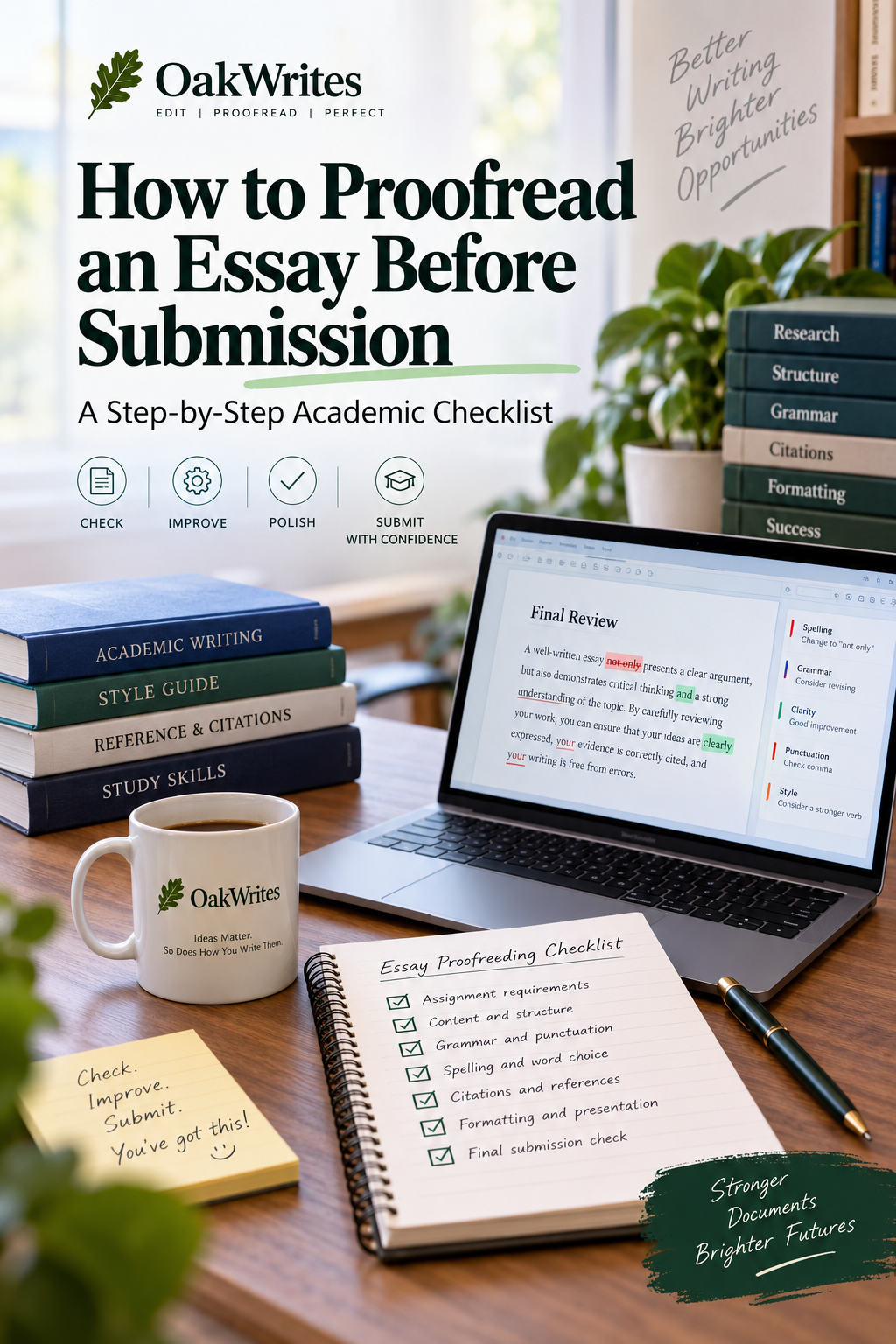
25-Point Essay Proofreading Checklist
Use this checklist immediately before submission.
Assignment Requirements
- ☐ I answered every part of the question.
- ☐ I followed the required structure.
- ☐ I stayed within the required word count.
- ☐ I followed the rubric.
Argument and Organization
- ☐ My thesis is clear.
- ☐ Every paragraph supports the central argument.
- ☐ Ideas appear in a logical order.
- ☐ Transitions are clear.
- ☐ My conclusion reflects the argument actually presented.
Language
- ☐ Sentences are clear.
- ☐ Grammar is correct.
- ☐ Verb tenses are consistent.
- ☐ Subject-verb agreement is correct.
- ☐ Spelling is correct.
- ☐ Punctuation is correct.
- ☐ Capitalization is consistent.
- ☐ Unnecessary repetition has been removed.
Evidence and Referencing
- ☐ Claims that require evidence are supported.
- ☐ In-text citations are correctly formatted.
- ☐ Every required reference is included.
- ☐ The reference list follows the required style.
Formatting and Submission
- ☐ Headings are consistent.
- ☐ Font and spacing follow instructions.
- ☐ Page numbers are correct.
- ☐ The final file format is correct.
- ☐ I have included every required attachment.
Should You Proofread Your Essay on the Screen or on Paper?
Both approaches can be useful.
When proofreading on a screen, consider changing the viewing conditions. Increasing the zoom or using a different document view can help you notice errors that become invisible through familiarity.
Some writers also find it useful to print the document. A printed page can make inconsistencies more visible because the essay looks different from the screen version in which it was created.
Another technique is to read the essay backward, sentence by sentence. You are not trying to understand the argument in reverse. Instead, the unfamiliar sequence makes it harder for your brain to anticipate what comes next.
Reading aloud is another useful technique. The goal is to interrupt the familiarity that develops after repeatedly reading your own writing.
Should You Use Grammar Checkers When Proofreading?
Yes—but use them as a support tool rather than a replacement for judgment.
Grammar and spelling software can help identify possible:
- Spelling errors
- Repeated words
- Punctuation problems
- Grammar issues
- Readability concerns
However, software does not understand every aspect of an academic argument.
A sentence can be grammatically correct but still be irrelevant, unsupported, ambiguous, logically inconsistent, or poorly connected to the paragraph.
For that reason, automated suggestions should be reviewed rather than accepted automatically.
Common Proofreading Mistakes Students Make
Proofreading Too Early
If you continue making major changes after proofreading, you may introduce new errors. Finish substantive revisions first.
Trying to Check Everything at Once
Checking grammar, citations, formatting, argument, spelling, and structure simultaneously can make the process unnecessarily difficult. Use separate passes.
Only Looking for Spelling Mistakes
Proofreading involves much more than spelling. Citations, formatting, punctuation, consistency, and missing words can also affect the quality of a final document.
Reading Too Quickly
Familiarity makes errors easier to overlook. Slow down and deliberately examine each part of the document.
Relying Completely on Software
Automated tools can identify possible errors, but they cannot replace careful human judgment.
Leaving Proofreading Until Five Minutes Before Submission
A rushed final check makes it easier to overlook mistakes. Give yourself enough time to correct errors and review the final document afterward.
When Should You Get Professional Proofreading?
Self-proofreading is a valuable academic skill, but professional proofreading can provide another level of review when a document is important or when you have spent so much time with the draft that errors are difficult to see.
Consider professional proofreading when:
- You have completed the substantive revisions.
- You want another person to review the final document.
- English is not your first language.
- The document is long.
- The submission is particularly important.
- You have difficulty identifying recurring grammar errors.
- You need help checking formatting or citation consistency.
- Your deadline leaves little time for another full review.
The key is to understand what the service includes.
Proofreading should not be confused with having someone produce your academic work for you. A legitimate editing or proofreading service should work with your existing document and the applicable academic requirements rather than replacing your authorship.
What If Your Essay Needs More Than Proofreading?
Sometimes students reach the proofreading stage and discover that the document has deeper problems.
For example:
- The thesis is unclear.
- Paragraphs do not flow logically.
- The writing is unnecessarily repetitive.
- The academic tone is inconsistent.
- Some sections are difficult to understand.
- The organization needs improvement.
In these situations, proofreading alone may not be enough. You may need editing before proofreading.
Revision → Editing → Proofreading → Final Submission Check
OakWrites provides editing and proofreading support for client-supplied documents, including assistance with grammar, clarity, flow, formatting, and document presentation.
Final Proofreading Checklist: The 5-Minute Version
If you are short on time, prioritize these five areas:
- Assignment requirements — Did you answer the actual question?
- Argument — Is the thesis clear and supported?
- Language — Are there obvious grammar, spelling, and punctuation errors?
- References — Are citations and references consistent?
- Formatting — Does the final document follow the required style?
If you have more time, complete the full checklist above.
Frequently Asked Questions
What is the best way to proofread an essay?
The most effective approach is to proofread in separate passes. First confirm that the essay is complete and structurally sound, then check sentence-level clarity, grammar, spelling, punctuation, citations, references, formatting, and final submission requirements.
When should I proofread my essay?
Proofread after completing major revisions and editing. If you make substantial changes after proofreading, perform another final proofreading pass.
What should I check when proofreading an essay?
Check grammar, spelling, punctuation, sentence structure, consistency, citations, references, formatting, headings, page numbers, and assignment requirements.
Is proofreading the same as editing?
No. Editing is generally broader and can address clarity, flow, organization, sentence structure, and academic expression. Proofreading is the final focused check for remaining errors and inconsistencies.
Can I proofread my own essay?
Yes. Reading slowly, taking a break before reviewing, reading aloud, checking one type of error at a time, and using a structured checklist can make self-proofreading more effective.
Should I use Grammarly or another grammar checker?
Grammar checkers can be useful for identifying possible language errors, but their suggestions should be reviewed critically. They cannot reliably judge the quality of an academic argument, evidence, or assignment requirements.
Should citations be checked during proofreading?
Yes. A final review should check citation consistency, reference-list entries, formatting, and whether required sources are correctly documented according to the specified style.
How long does proofreading an essay take?
There is no single amount of time that applies to every essay. The required time depends on the document's length, complexity, quality, formatting requirements, and number of remaining errors.
Is professional proofreading worth it?
Professional proofreading can be useful when you need an additional review of a finalized document, particularly for important submissions or recurring language and formatting issues. The value depends on what the service covers and whether the document genuinely needs another level of review.
Key Takeaways
Proofreading is the final quality-control stage, not a substitute for writing or substantive editing.
For the best results:
- Finish your major revisions first.
- Check the assignment requirements.
- Review the thesis and argument.
- Examine paragraph flow.
- Check grammar and sentence structure.
- Review spelling and punctuation.
- Verify citations and references.
- Check formatting.
- Read the final document carefully.
- Perform one last submission check after making corrections.
Most importantly, do not proofread only for spelling mistakes. A strong final review considers the entire presentation of your finished work while keeping proofreading separate from deeper editorial changes.
Need a Second Set of Eyes Before Submission?
If your essay is already written but you want another review for grammar, clarity, flow, formatting, citations, or overall document quality, OakWrites can help.
Submit your document and instructions for a personalized quotation before your final submission.
Sources & Further Reading
Need Help With Your Assignment?
Submit your instructions through the OakWrites Client Portal. We will review your request and provide a personalized quotation before asking for payment.
Start Your AssignmentRelated Articles