Essay Editing Checklist: 25 Things to Check Before You Submit
OakWrites Student Resource
Essay Editing Checklist: 25 Things to Check Before You Submit
Use this practical, step-by-step checklist to strengthen your argument, improve clarity, correct citations, polish your academic tone, and submit your essay with confidence.
You have completed the research, written the final paragraph, and checked the word count. At this point, clicking Submit may feel like the only task left. However, the final editing stage is where many avoidable problems can still be found and corrected.
One of the most common issues we see while reviewing academic papers is that strong ideas are weakened by unclear thesis statements, uneven paragraph structure, unsupported claims, inconsistent citations, or rushed proofreading. These problems do not always require a complete rewrite. In many cases, a systematic final review can make the essay clearer, more persuasive, and easier to assess.
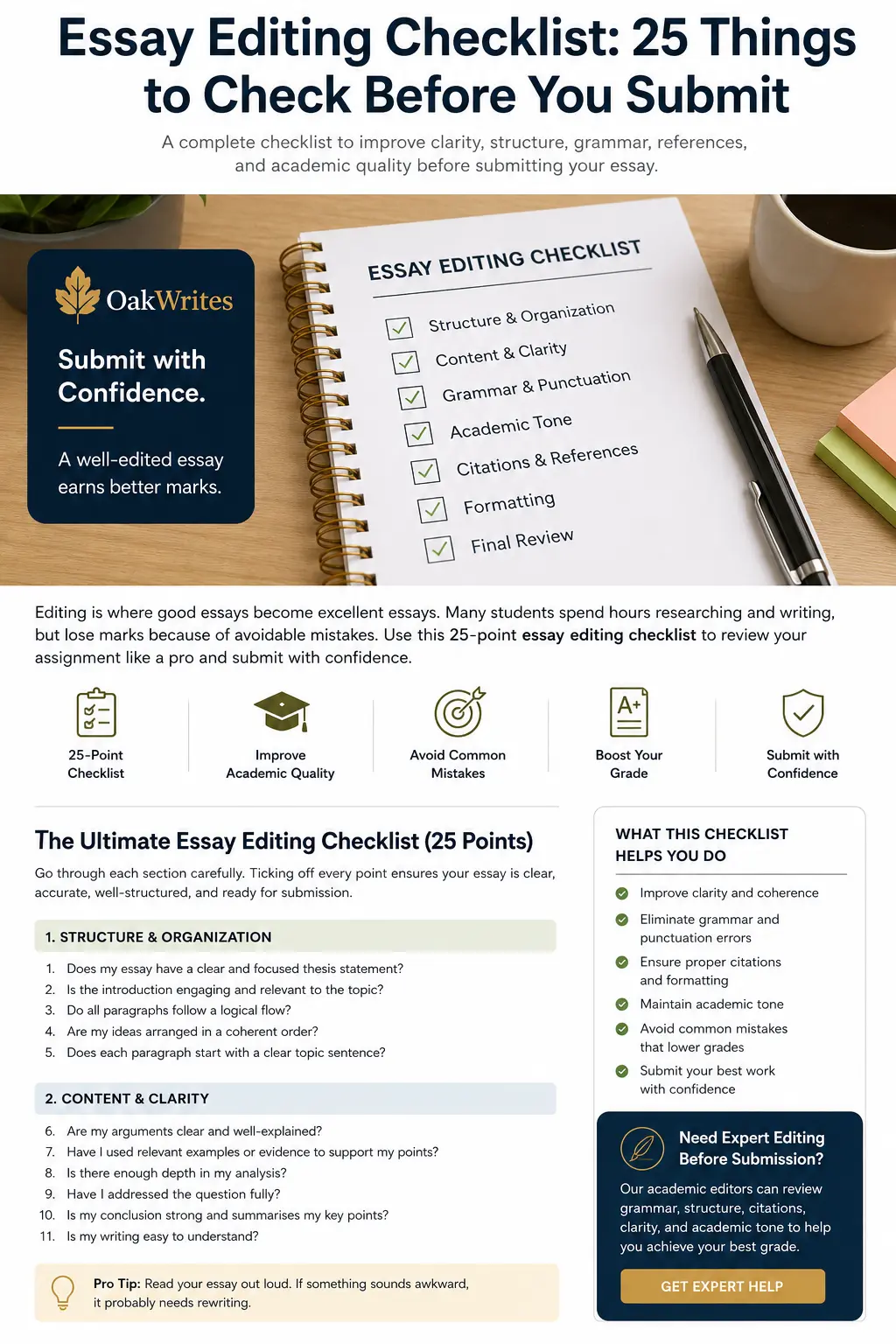
This 25-point essay editing checklist moves from large issues, such as argument and organization, to smaller details, such as punctuation and formatting. Work through it in order rather than correcting random sentences as you notice them.
Why Essay Editing Matters
Writing and editing are related, but they are not the same task. Writing helps you develop and express ideas. Editing tests whether those ideas are clear, relevant, logically organized, adequately supported, and presented in the required academic style.
A final review can help you identify missing evidence, remove repetition, improve transitions, correct referencing errors, and make your argument easier to follow. Proofreading should come last because correcting commas is less useful when a paragraph may still need to be moved, shortened, or rewritten.
| Stage | Main focus | Typical questions |
|---|---|---|
| Revising | Ideas, argument, evidence, and organization | Did I answer the question? Is my argument convincing? |
| Editing | Clarity, academic tone, flow, and sentence quality | Is this precise? Does each sentence contribute? |
| Proofreading | Grammar, spelling, punctuation, and formatting | Are there errors or inconsistencies in the final draft? |
Assignment and Argument Checks
1Have you answered the exact question?
Read the assignment prompt again and identify every instruction word, such as analyze, compare, evaluate, or discuss. Your essay should perform the requested task, not merely provide background information about the topic.
2Is your thesis specific and arguable?
Your thesis should state the position or central claim your essay will defend. Avoid a thesis that only announces the subject.
Weak: This essay discusses social media and mental health.
Stronger: Although social media can support connection, frequent comparison-driven use can intensify anxiety among university students.
3Does every major point support the thesis?
Remove interesting details that do not help prove your main argument. A paragraph may be well written and still be unnecessary if it does not advance the essay's purpose.
4Have you addressed reasonable counterarguments?
For argumentative or analytical essays, briefly acknowledging an opposing view can make your position more credible. Explain why your interpretation remains stronger rather than ignoring alternatives.
5Is the scope manageable?
Check whether your essay attempts to prove too much within the available word count. A focused argument supported in depth is usually stronger than several broad claims explained superficially.
Editor tip: Create a reverse outline
Write one short sentence beside each paragraph explaining its purpose. If two paragraphs perform the same job, combine or distinguish them. If a paragraph has no clear purpose, revise or remove it.
Structure and Organization Checks
6Does the introduction establish direction?
Your introduction should orient the reader, define the issue when necessary, and lead naturally to the thesis. Avoid beginning with an overly broad statement that could introduce almost any essay.
7Does each paragraph have one central idea?
A paragraph should not shift between unrelated claims. Its topic sentence, evidence, analysis, and closing connection should work together to develop one main point.
8Are paragraphs arranged logically?
Arrange ideas according to a clear principle, such as importance, chronology, cause and effect, comparison, or stages in an argument. The strongest order is the one that makes the reasoning easiest to follow.
9Do transitions show relationships?
Use transitions to explain whether the next idea adds evidence, introduces contrast, presents a consequence, or gives an example. Avoid adding transition words mechanically when the logical connection is unclear.
10Does the conclusion provide closure?
The conclusion should synthesize the main argument, reinforce its significance, and leave the reader with a clear final understanding. Do not introduce major new evidence in the final paragraph.
Evidence and Analysis Checks
11Is every important claim supported?
Identify statements that a reader could reasonably question. Support factual claims with credible evidence and make clear when a statement is your interpretation.
12Are your sources appropriate?
Check whether the assignment requires peer-reviewed research, recent sources, primary evidence, course materials, or a minimum number of references. Replace weak sources when more authoritative evidence is available.
13Have you analyzed rather than summarized?
After presenting evidence, explain what it demonstrates, why it matters, and how it supports your thesis. A quotation or statistic should not be expected to explain itself.
14Are quotations integrated smoothly?
Introduce quoted material, provide the required citation, and explain its relevance. Avoid dropping a quotation into a paragraph without grammatical or analytical connection.
15Have you checked names, dates, and figures?
Verify all factual details against the original sources. A correctly formatted citation cannot compensate for an inaccurate statistic, date, spelling, or interpretation.
Need Help Before Submission?
OakWrites can review grammar, structure, citations, formatting, clarity, and academic tone so you can submit a more polished final draft.
Clarity and Academic Style Checks
16Is your language precise?
Replace vague words such as things, good, bad, or a lot with language that communicates the exact meaning. Precision is more valuable than unnecessarily complex vocabulary.
17Is the tone appropriately academic?
Use a professional tone suited to your discipline and assignment. Remove casual expressions, unsupported exaggeration, conversational fillers, and emotional language unless the task requires personal reflection.
18Have you removed repetition?
Look for repeated claims, examples, transition phrases, and conclusion-like sentences. Repetition can make an essay longer without making it stronger.
19Are sentences easy to follow?
Break up sentences that contain too many clauses or ideas. Vary sentence length, but prioritize clarity. Reading the essay aloud often reveals awkward phrasing that silent reading misses.
20Have you reduced unnecessary words?
Delete phrases that add length without meaning. For example, replace “due to the fact that” with “because” and “in order to” with “to” unless the longer form is genuinely needed.
Citation and Formatting Checks
21Is every borrowed idea cited?
Citations are required for quotations, paraphrases, statistics, theories, and ideas that are not common knowledge. Review each paragraph and identify material that came from another source.
22Do in-text citations match the reference list?
Every cited source should appear in the reference list, and every reference-list entry should normally be cited in the paper. Check author names and publication years carefully.
23Is the required citation style consistent?
Follow the specified APA, MLA, Chicago, Harvard, or institutional rules consistently. Pay attention to capitalization, italics, punctuation, author order, page numbers, and hanging indents.
24Does the document follow submission requirements?
Confirm the required font, spacing, margins, page numbers, title page, running head, section headings, file type, naming convention, and word-count rules.
25Have you completed a final proofread?
Proofread only after the content is stable. Check spelling, punctuation, grammar, missing words, repeated words, capitalization, heading consistency, and accidental formatting changes.
Printable Final Essay Checklist
Use the boxes below as your final submission review. The checklist can also be printed directly from your browser.
Common Essay Editing Mistakes to Avoid
| Mistake | Why it causes problems | Better approach |
|---|---|---|
| Editing immediately after writing | Familiarity makes errors harder to notice. | Take a short break before reviewing the draft. |
| Correcting grammar first | You may polish sentences that later need to be deleted. | Review argument and structure before proofreading. |
| Relying only on automated tools | Tools may miss context, logic, citation issues, or inaccurate suggestions. | Use tools as support, then review every suggestion yourself. |
| Reading only on screen | The same visual format can make familiar errors less noticeable. | Change the font, print the paper, or read it aloud. |
| Assuming citations are correct | Small inconsistencies can remain throughout the paper. | Complete a separate citation and reference-list audit. |
Frequently Asked Questions
What should I check before submitting an essay?
Check the assignment requirements, thesis, paragraph structure, evidence, analysis, transitions, conclusion, academic tone, citations, reference list, formatting, grammar, spelling, and file-submission instructions.
What is the difference between editing and proofreading?
Editing improves argument, organization, clarity, flow, and style. Proofreading is the final check for grammar, spelling, punctuation, and formatting errors after major revisions are complete.
How long should I spend editing an essay?
The time required depends on the essay's length and condition. Leave enough time to review the argument and structure separately from the final proofread rather than attempting everything minutes before the deadline.
How many times should I proofread my essay?
There is no universal number, but separate passes are usually more effective. You might review structure first, evidence second, citations third, and grammar and formatting last.
Can AI edit an academic essay?
AI tools can help identify wording or grammar issues, but their suggestions may be inaccurate or unsuitable for your assignment. You remain responsible for the argument, evidence, citations, originality, and compliance with your institution's rules.
Should someone else review my essay?
A second reader may notice unclear reasoning and errors that the writer has become too familiar with. Ensure any assistance follows your institution's academic-integrity requirements.
Can an editor guarantee a particular grade?
No responsible editor can guarantee a grade because assessment depends on the rubric, instructor, evidence, argument, and the student's own work. Editing can improve presentation and identify weaknesses, but it cannot guarantee an academic outcome.
Submit a Stronger Final Draft
A strong essay is rarely produced in one uninterrupted draft. The final quality depends on whether you step back, test the argument, reorganize unclear sections, strengthen evidence, verify citations, and proofread the finished document carefully.
Work through this checklist from the largest issues to the smallest. Begin with the assignment question and thesis, then review organization, evidence, analysis, clarity, references, formatting, and grammar. This order prevents you from spending time polishing sentences that may still need substantial revision.
Submit With Greater Confidence
Our editors can review grammar, clarity, structure, citations, formatting, and academic tone before your deadline while preserving your ideas and voice.
Related OakWrites Resources
Update any link above if your WordPress page uses a different URL.
Need Help With Your Assignment?
Submit your instructions through the OakWrites Client Portal. We will review your request and provide a personalized quotation before asking for payment.
Start Your Assignment