Essay Editing vs. Proofreading: What’s the Difference (and Which One Do You Actually Need?)
Essay Editing vs. Proofreading: What’s the Difference and Which Do You Need?
Editing and proofreading both improve an essay, but they solve different problems. This guide will help you choose the right service before your submission deadline.
You have finished your essay, but something still feels wrong. The grammar may be acceptable, yet the argument seems difficult to follow. Perhaps your ideas are strong, but small spelling and punctuation errors remain. At this point, should you request essay editing or proofreading?
The answer depends on whether your paper needs deeper improvements or a final surface-level check. Editing improves how effectively your ideas are organized and expressed. Proofreading checks the completed paper for remaining grammar, spelling, punctuation, formatting and consistency errors.
Choosing the wrong service can leave important weaknesses unresolved. A proofreader, for example, may correct commas and spelling without restructuring an unclear argument. An editor may improve awkward sentences and weak transitions, but the document should still receive a final proofread before submission.
Editing vs. Proofreading at a Glance
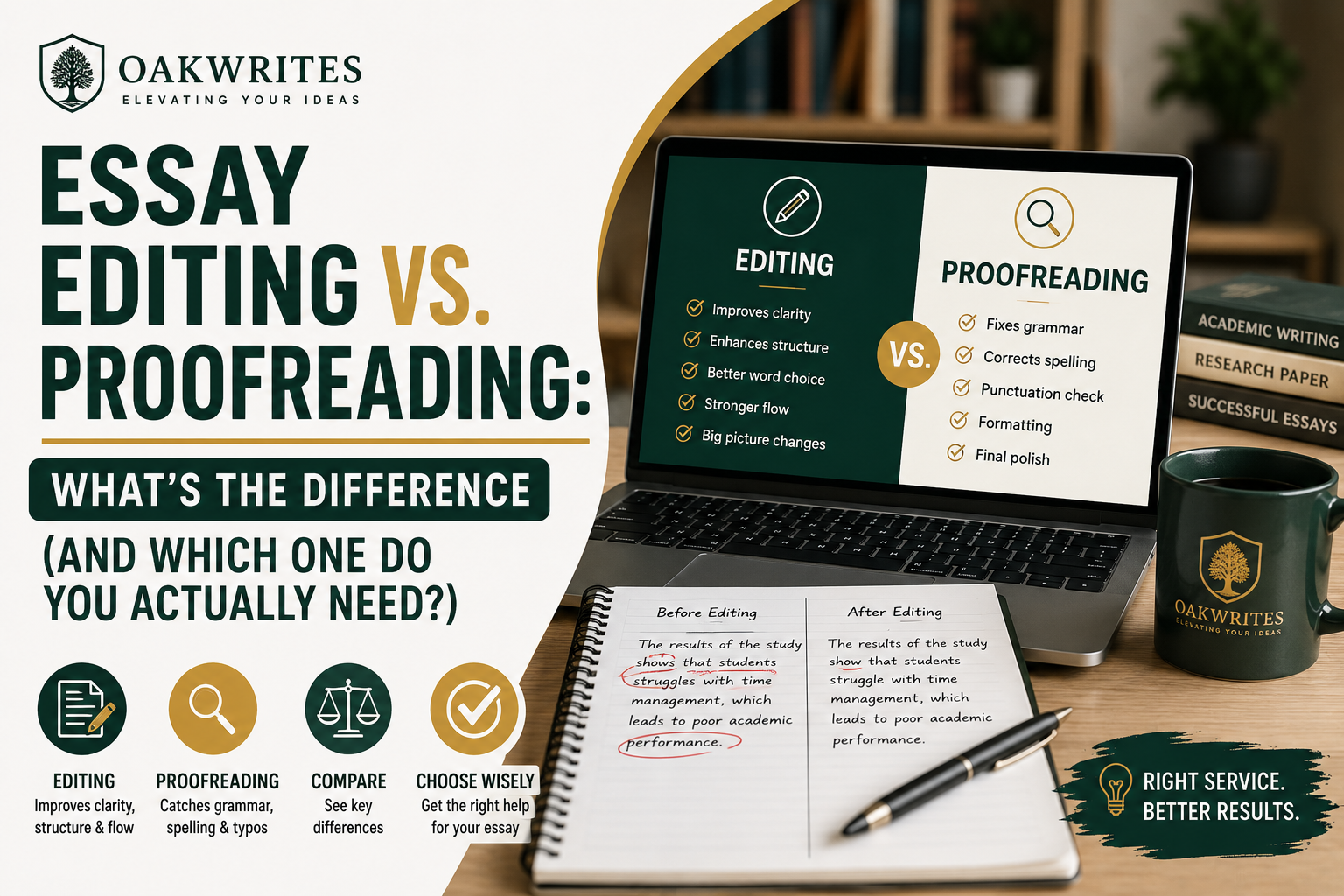
Editing improves the quality and communication of your writing. It may address clarity, sentence structure, word choice, tone, flow, repetition and organization.
Proofreading is the final quality check. It catches remaining spelling, grammar, punctuation, capitalization, formatting and typographical errors after the content has been finalized.
What Is Essay Editing?
Essay editing is a detailed review designed to strengthen the way a paper communicates its ideas. An editor does more than identify isolated grammatical mistakes. The editor considers whether sentences are clear, paragraphs flow logically and the language is appropriate for the assignment.
Depending on the level of editing requested, the process may include revising awkward sentences, removing repetition, improving transitions, tightening wordy sections and identifying places where the argument needs clarification. More extensive editing may also address the relationship between the thesis, body paragraphs and conclusion.
Areas commonly covered during essay editing
- Clarity and readability
- Sentence structure and variety
- Word choice and academic tone
- Paragraph development
- Transitions between ideas
- Repetition and unnecessary wording
- Consistency of tense, voice and terminology
- Organization of arguments and supporting points
- Alignment between the introduction, thesis and conclusion
- Formatting and citation consistency when included in the service
Editing does not necessarily mean rewriting the entire paper. A responsible editor preserves the writer’s central ideas and intended meaning while improving how those ideas are presented. The amount of intervention should reflect the condition of the draft and the scope of the service requested.
What Is Essay Proofreading?
Proofreading is the final review performed after the essay’s ideas, structure and wording are already settled. It focuses primarily on surface-level mistakes that can make an otherwise strong paper appear unfinished.
The University of North Carolina Writing Center describes proofreading as the final stage of the editing process and recommends completing major revisions before beginning the proofread. This sequence matters because changing, deleting or adding paragraphs after proofreading can introduce new mistakes.
Areas commonly covered during proofreading
- Spelling and typographical errors
- Grammar and verb agreement
- Punctuation and capitalization
- Missing or repeated words
- Spacing and indentation
- Heading and font consistency
- Page numbers and basic layout
- Inconsistent abbreviations
- Minor citation and reference-list inconsistencies
- Formatting details required by the selected style
Proofreading is not intended to repair a weak thesis, reorganize several paragraphs or develop missing evidence. Those problems require revision or editing before the final proofread begins.
Editing vs. Proofreading: Key Differences
| Area | Essay Editing | Essay Proofreading |
|---|---|---|
| Main purpose | Improve clarity, flow, style and overall communication. | Remove remaining surface-level errors before submission. |
| Stage | After revising the content but before the final proofread. | After all writing, revising and editing are complete. |
| Depth | Moderate to detailed changes. | Minor and highly focused corrections. |
| Sentence structure | May rewrite awkward, unclear or repetitive sentences. | Usually changes a sentence only to correct a clear error. |
| Organization | May identify weak paragraph order, transitions or logical flow. | Does not normally reorganize the paper. |
| Word choice | Improves precision, conciseness, tone and academic language. | Corrects obvious misuse, spelling or inconsistency. |
| Grammar | Corrects grammar while also improving style and readability. | Corrects remaining grammatical mistakes. |
| Best for | Drafts that are complete but still unclear, wordy or uneven. | Strong, finalized drafts that need one last quality check. |
A Simple Editing and Proofreading Example
The easiest way to understand the difference is to see what happens to the same sentence at each stage.
Before
Due to the fact that social media is used by a lot of college students, it can have many different effects on their academic performance and this is something that needs to be looked at.
After editing
Because social media is widely used by college students, its effects on academic performance require careful examination.
The edited version is more concise, direct and academic. It removes unnecessary wording, replaces vague language and improves the sentence’s focus. These are editorial changes rather than simple corrections.
Before
Because social media is widely used by college students its effects on academic performance requires careful examination.
After proofreading
Because social media is widely used by college students, its effects on academic performance require careful examination.
Here, the wording and meaning remain the same. The proofreader adds the missing comma and changes “requires” to “require” so that the verb agrees with the plural subject “effects.”
Which Service Does Your Essay Need?
Your decision should be based on the condition of the document, not simply how close the deadline is. Read several paragraphs slowly and evaluate both the ideas and the language.
Your essay needs editing when:
- The argument is difficult to follow.
- Some paragraphs feel disconnected.
- Your sentences are wordy or repetitive.
- The tone sounds informal or inconsistent.
- You are unsure whether ideas flow logically.
- English is not your first language and expression is a concern.
- Your instructor says the paper lacks clarity or organization.
- You have made major additions that need to be integrated.
Your essay needs proofreading when:
- The thesis and argument are already clear.
- The paragraphs are complete and logically ordered.
- You are satisfied with the wording and academic tone.
- You have finished all major revisions.
- You mainly need grammar and spelling corrections.
- You want formatting inconsistencies identified.
- The paper has already received detailed feedback.
- You are preparing the final version for submission.
A Fast Decision Test
- Ask: “Do my ideas make sense and appear in the right order?” If the answer is no or you are uncertain, choose editing.
- Ask: “Would I keep every paragraph and sentence essentially as it is?” If no, choose editing.
- Ask: “Do I only need the final mistakes corrected?” If yes, choose proofreading.
- Ask: “Has the paper been changed since its last detailed review?” If yes, it may need another editing pass before proofreading.
Can an Essay Need Both Editing and Proofreading?
Yes. In fact, editing and proofreading are normally consecutive stages rather than competing alternatives. A paper is first revised for its content and organization, edited for clarity and expression, and then proofread for final errors.
This order prevents wasted effort. Imagine carefully proofreading a paragraph and then deciding during editing that the entire paragraph should be replaced. You would need to proofread the replacement again. Completing deeper changes first makes the final review more efficient.
A combined service can be useful when your draft is complete but you are unsure which level of help it needs. The editor can improve clarity and style before checking the resulting document for smaller mistakes. However, you should confirm exactly what the service includes because editing packages vary between providers.
Not Sure Which Service to Select?
Submit your draft and instructions to OakWrites for review. We will assess the document and provide a personalized quotation before payment.
Different Levels of Essay Editing
The word “editing” can describe several levels of review. Understanding them helps you communicate what your paper needs and compare services more accurately.
1. Developmental or substantive editing
This is the deepest level. It considers the overall purpose, argument, organization and development of the document. For an academic essay, it may identify an unclear thesis, unsupported claims, misplaced sections or gaps in reasoning.
Developmental editing can lead to significant changes, but academic integrity boundaries remain important. The student should remain responsible for the argument, research decisions and final submission.
2. Line editing
Line editing examines how ideas are expressed at sentence and paragraph level. It improves rhythm, clarity, tone, transitions and readability. An editor may shorten wordy sentences, replace vague expressions and make paragraph connections clearer.
3. Copy editing
Copy editing focuses on correctness, consistency and style. It may address grammar, syntax, word choice, capitalization, terminology, abbreviations and style-guide requirements. Copy editing is generally more detailed than proofreading but less structural than developmental editing.
4. Proofreading
Proofreading comes last. It looks for mistakes that remain after the document has passed through the earlier stages. Changes should be limited because the content is considered complete.
Do You Need a Human Editor if You Use Grammar Tools?
Grammar and spell-checking tools can be useful during self-editing. They can quickly flag possible spelling, punctuation and sentence-level problems. However, suggestions should not be accepted automatically. Software may misunderstand specialized terminology, discipline-specific language or the intended meaning of a sentence.
Automated tools are also less reliable when the problem involves the logic of an argument, missing context, weak paragraph development or inconsistent interpretation of evidence. A sentence may be grammatically correct but still be vague, misleading or unsuitable for the assignment.
A sensible approach is to use automated tools for an initial check and then review every suggestion critically. A human editor becomes especially valuable when the paper is important, the language needs substantial improvement or you are too familiar with the draft to notice its weaknesses.
How to Edit and Proofread Your Own Essay
Professional support is not always necessary. When your deadline and confidence allow, you can improve your own work by separating the revision, editing and proofreading stages.
Self-editing checklist
- Confirm that the essay answers every part of the instructions.
- Underline the thesis and check whether it makes a specific claim.
- Write the main idea of each paragraph in the margin.
- Check that every body paragraph supports the thesis.
- Remove information that does not serve the argument.
- Add transitions where the relationship between ideas is unclear.
- Shorten long sentences and remove repeated wording.
- Replace vague words with precise academic language.
- Check that the conclusion reflects the argument actually presented.
Self-proofreading checklist
- Take a break before reading the final draft.
- Read slowly and aloud to prevent yourself from skimming.
- Check one type of error at a time.
- Review headings, fonts, spacing and page numbers.
- Check citations against the reference list.
- Confirm consistent capitalization and abbreviations.
- Read sentences in reverse order to focus on wording rather than ideas.
- Review the document after converting or uploading it.
- Perform one final check after making corrections.
Common Mistakes When Choosing a Service
Choosing proofreading for an early draft
Proofreading an unfinished draft can create the appearance of correctness without resolving deeper problems. A grammatically clean essay can still have an unclear thesis, weak analysis or poor organization.
Assuming every editing service includes the same work
Some providers use “editing” to mean grammar correction, while others include extensive sentence rewriting and structural feedback. Review the service description and ask what will be changed before ordering.
Waiting until immediately before the deadline
Editing may reveal that you need to add evidence, clarify a claim or revise a section. Leaving no time to review the editor’s changes reduces the value of the service and increases the risk of submitting corrections you do not understand.
Expecting an editor to guarantee a grade
Editing can strengthen presentation, but a grade also depends on the quality of the research, argument, evidence, interpretation and alignment with the rubric. No responsible service should guarantee a specific academic result.
Ignoring academic-integrity requirements
Institutions have different rules about external editing and artificial intelligence. Check your course or university policy, especially when the service involves substantial rewriting. You should understand, approve and take responsibility for the final version.
What to Provide Before Hiring an Editor
The quality of the review depends partly on the information supplied. Sending only the essay may prevent the editor from identifying whether the paper matches the assignment.
Essential materials
- The latest version of your essay
- The assignment prompt
- The marking rubric
- The required citation style
- The submission deadline
Helpful additional materials
- Instructor or supervisor feedback
- A formatting template
- Previous drafts with comments
- Specific concerns you want reviewed
- Institutional editing rules
Always send the most recent file and label it clearly. If several versions are provided without explanation, the editor may work on the wrong draft.
Does Editing Cost More Than Proofreading?
Editing usually costs more than proofreading because it requires a deeper review and more substantial intervention. The exact price may depend on the document length, condition of the writing, turnaround time, academic level and formatting requirements.
OakWrites currently lists editing and proofreading services starting at $4 per page. A personalized quotation is prepared after the assignment instructions, document and deadline have been reviewed. This allows the final price to reflect the actual work required rather than relying only on page count.
When comparing quotations, consider scope as well as price. A low-cost proofread will not offer good value when your essay actually requires detailed editing. Similarly, paying for extensive editing may be unnecessary when the paper is already clear and only contains minor errors.
The Final Answer: Editing or Proofreading?
Choose essay editing when the paper’s wording, clarity, flow or organization still needs improvement. Choose proofreading when the essay is complete and you only need a final check for grammar, spelling, punctuation and formatting errors.
When the draft needs both, edit first and proofread last. This order ensures that deeper changes are completed before the final quality check. Most importantly, select a service based on the condition of your paper rather than the service name alone.
Give Your Essay a Strong Final Review
OakWrites can help improve clarity, grammar, sentence structure, formatting and overall document quality. Upload your draft and instructions to receive a personalized quotation.
Frequently Asked Questions
Is editing the same as proofreading?
No. Editing improves clarity, sentence structure, word choice, flow and sometimes organization. Proofreading is the final review for spelling, grammar, punctuation, formatting and typographical errors after the content has been finalized.
Should editing or proofreading come first?
Editing should come first. Complete all changes to the ideas, structure and wording before proofreading the final version. Otherwise, later edits may introduce new errors.
Can a proofreader improve my argument?
Not normally. A proofreader may flag an obvious inconsistency, but developing or reorganizing an argument falls under revision or substantive editing. Confirm the service scope before ordering.
Can editing change my writing style?
Editing may refine tone and expression, but a responsible editor should preserve your intended meaning and appropriate authorial voice. Tell the editor when maintaining a particular style is especially important.
Is Grammarly enough for proofreading an essay?
Grammar tools can identify many possible errors, but their suggestions still require judgment. They may misunderstand context, technical vocabulary or intended meaning. Important papers may benefit from an additional human review.
How long should I leave for editing and proofreading?
Leave enough time for the editor to review the document and for you to examine the changes before submission. Longer, highly technical or heavily edited documents generally require more time than short, polished essays.
Can OakWrites edit citations and formatting?
OakWrites provides formatting assistance as part of its editing and proofreading support. Include the required citation style, assignment instructions and rubric so the requested scope can be evaluated before a quotation is prepared.
How much does OakWrites charge for editing?
OakWrites lists editing and proofreading services starting at $4 per page. The final quotation depends on the document, instructions, deadline and amount of work required.
Continue Reading
Sources and Further Reading
- University of North Carolina Writing Center. Editing and Proofreading .
- Grammarly. Revising vs. Editing vs. Proofreading: What’s the Difference? .
- Scribbr. What Is the Difference Between Proofreading and Editing? .
- University of Kansas Writing Center. Editing and Proofreading .
Need Help With Your Assignment?
Submit your instructions through the OakWrites Client Portal. We will review your request and provide a personalized quotation before asking for payment.
Start Your Assignment