Reverse Outline for Essay Editing: 6 Powerful Checks for a Clearer Argument

Direct answer: A reverse outline is a short outline made from a draft you have already written. To use one for essay editing, summarize the main point of each paragraph, compare those points with your thesis and assignment prompt, then revise paragraphs that are unclear, misplaced, repetitive, or unrelated. It helps you assess structure before spending time polishing individual sentences.
Essay editing is more than correcting grammar. A draft can be grammatically sound and still have an unclear argument, paragraphs in the wrong order, or evidence that does not explain how it supports the thesis. A reverse outline gives you a practical way to spot these larger issues. It is especially useful when an essay feels difficult to follow but you are not sure where the problem begins.
This guide shows how to make a reverse outline, interpret what it reveals, and use it as part of a careful essay-editing process. The aim is not to force every essay into the same structure. It is to help you make purposeful decisions while preserving your own argument and voice.
What is a reverse outline?
A reverse outline is a brief map of what a completed or partly completed essay actually says. Instead of planning the points before drafting, you read the draft paragraph by paragraph and record each paragraph’s central idea and role in the argument. The resulting outline shows the structure on the page—not just the structure you intended to write.
That difference matters during essay editing. Your initial plan may have changed as you researched or drafted. A paragraph may now contain a useful point that was not in the original outline, while another may repeat an earlier claim or drift away from the prompt. A reverse outline helps you assess the draft as it exists now.
University writing-center guidance commonly presents reverse outlining as a way to review organization, paragraph focus, and the connection between the thesis and supporting points. For example, the University of Wisconsin–Madison Writing Center’s reverse-outlining guide explains how mapping paragraph functions can help writers decide what to keep, cut, or rearrange. The Oregon State University Writing Center also describes using the method to examine organization and the relationship between paragraphs and the larger topic.
When should you use one for essay editing?
Use a reverse outline after you have enough of a draft to see how the main ideas develop. You do not need a perfect final draft: a complete first draft is often a good time to begin structural editing, and outlining one section can help if the essay is still in progress.
It is particularly helpful when:
- Your thesis is clear to you, but the essay’s progression feels confusing.
- You are unsure whether every paragraph contributes to the prompt or central claim.
- Two or more paragraphs seem to make the same point.
- You have added research and examples but are unsure where they belong.
- The conclusion introduces a new idea that does not appear to follow from the body.
- You want to check the argument’s structure before line editing or proofreading.
A reverse outline is not a substitute for checking grammar, punctuation, citations, or formatting. It answers a different question: Does the essay’s organization help readers follow its purpose and reasoning? Address those big-picture questions before concentrating on sentence-level corrections.
How to create a reverse outline in six steps
- Put the prompt and thesis beside the draft. Keep the assignment instructions visible. Write your current thesis in one sentence. If the thesis has changed since you began drafting, use the claim the essay is actually trying to make now.
- Number the paragraphs. Work through the essay in its current order. Give each paragraph a number so you can refer to it easily when moving or revising sections.
- Summarize each paragraph in one sentence. Describe what the paragraph says, not what you hoped it would say. If you cannot summarize it without copying several sentences, the paragraph may contain multiple ideas or lack a clear focus.
- Record each paragraph’s job. Add a short note about its function: introduces a reason, explains evidence, gives context, addresses a counterargument, or draws an implication. Some paragraphs may perform more than one job, but note the main one.
- Connect each point to the thesis and prompt. Ask how the paragraph advances the main claim and whether it fulfills an assignment requirement. Mark a point as strong, unclear, repetitive, off-topic, or missing a link to the argument.
- Plan revisions before polishing sentences. Decide whether to keep, move, combine, split, expand, or remove a paragraph. If the outline exposes a mismatch between the draft and the thesis, consider revising the thesis too. Then make structural changes and reread the essay.
You can make the outline in a separate document, in a table, or in your draft’s margins. The format is less important than writing concise summaries and comparing them with the essay’s purpose. The George Mason University Writing Center’s explanation of reverse outlining similarly describes summarizing paragraph ideas to make the draft’s structure visible.
A short example: outline and edit a draft
Imagine an essay arguing that a university should extend library hours during exam periods. Its reverse outline might look like this:
| Paragraph | What the paragraph currently does | Editing question |
|---|---|---|
| 1 | Introduces exam-week study demands and the proposal to extend hours. | Does the introduction state a specific position? |
| 2 | Explains that students need access to quiet study space. | Does the evidence support this reason? |
| 3 | Describes late-night transportation concerns. | Is this a separate reason, or does it need a clearer connection? |
| 4 | Repeats that students need more time to study. | Does this add evidence or analysis beyond paragraph 2? |
| 5 | Mentions staffing costs and suggests a limited schedule. | Is this a counterargument with a response, or an unaddressed objection? |
| 6 | Restates the proposal and calls for student support. | Does the conclusion follow from the essay’s reasons? |
The outline suggests that paragraphs 2 and 4 may overlap. The writer could combine them, or revise paragraph 4 so it develops a different reason with relevant support. Paragraph 5 raises a practical objection; the writer might explain how a limited schedule could address staffing concerns. These are structural decisions. Correcting commas in paragraphs 2 and 4 before making them would risk polishing material that may later be moved or cut.
The table is a diagnostic, not a verdict. A paragraph does not have to follow a rigid formula, and an essay does not need one paragraph for every claim. The writer should check the prompt, evidence, and purpose before deciding what to change.
How to diagnose and fix common structure problems
Once you have the outline, read it from top to bottom without rereading the full essay. Look for patterns that are easier to notice in a short list than in several pages of prose.
One paragraph has several unrelated points
If a paragraph summary needs several distinct clauses, check whether it is doing too much. You might divide it so each paragraph develops a clearer point. Before splitting, identify the role of each part and make sure the new paragraphs still connect to the thesis.
Several paragraphs repeat the same idea
Repeated points can make an essay feel longer without advancing its argument. Compare the paragraphs’ claims and evidence. Combine them if they serve the same purpose, or revise one to contribute a distinct reason, qualification, or interpretation.
A paragraph has no clear connection to the thesis
Do not delete material automatically. Ask whether the paragraph supplies necessary context, evidence, or a counterargument. If it is relevant, make the connection explicit through analysis or a clearer topic sentence. If it does not support the essay’s purpose or assignment, consider cutting it.
The order makes the reasoning hard to follow
Try rearranging the outline items—not the full paragraphs at first. Consider whether a reader needs one point explained before another, whether the reasons build logically, and whether related ideas belong together. Then move the paragraphs and revise transitions so they accurately reflect the new order.
The thesis no longer matches the draft
Drafting can reveal that your strongest argument differs from your starting claim. Compare the thesis with the outline as a whole. You may need to narrow or clarify the thesis, or revise body paragraphs so they support the original position. Do not force an outdated thesis onto an essay whose evidence points elsewhere.
What to do after the outline
Use your notes to revise in order from larger choices to smaller ones:
- Structure: Move, combine, split, add, or remove paragraphs where the argument requires it.
- Development: Check whether each major claim has relevant evidence and explanation. A quotation or statistic does not interpret itself; explain how it supports the point.
- Paragraph focus: Revise topic sentences and supporting details so the paragraph’s purpose is easy to identify.
- Transitions: Add or adjust transitions only after the order is settled. Choose wording that describes the actual relationship between ideas rather than adding a transition phrase automatically.
- Sentence-level editing: Improve clarity, word choice, concision, and sentence flow while preserving your intended meaning and voice.
- Proofreading: Check grammar, spelling, punctuation, citation consistency, formatting, and submission requirements after substantive revisions are complete.
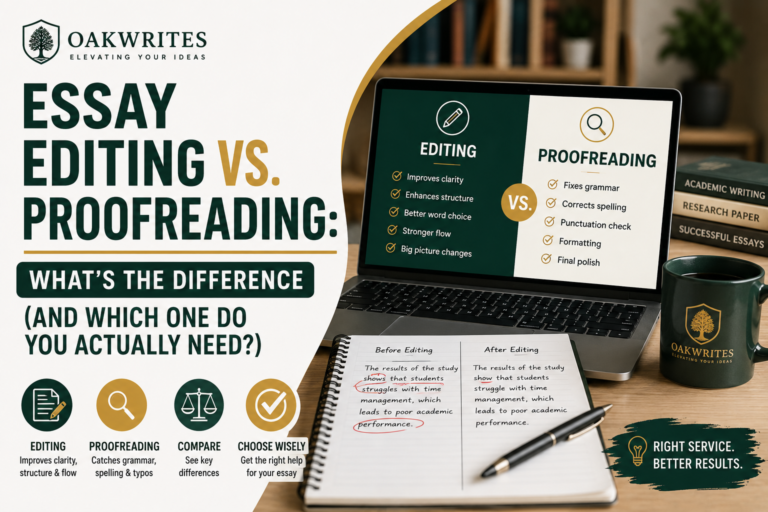
This sequence keeps essay editing focused: resolve argument and organization issues before investing time in polishing every sentence. For more guidance on paragraph focus, see OakWrites’ paragraph writing tips. If you need to distinguish broader editing from final proofreading, read essay editing vs. proofreading.
Common reverse-outlining mistakes
- Writing an ideal outline instead of an honest one. Describe what each paragraph actually does, including where it wanders or repeats.
- Summarizing too broadly. Notes such as “more evidence” do not reveal the paragraph’s claim. State the specific point in your own words.
- Treating the outline as a rigid template. Essays vary by discipline, prompt, and purpose. Use the outline to evaluate logic, not to impose a fixed number of paragraphs.
- Editing grammar before structure. Start with the argument and paragraph order; proofread after substantial revisions.
- Changing the essay just to make the outline look tidy. A neat list is not the goal. Keep changes that improve the essay’s reasoning and reader comprehension.
- Forgetting the assignment instructions. A logical outline can still miss a required perspective, source type, or section. Check the prompt and rubric during the review.
Frequently asked questions
Is a reverse outline the same as a regular essay outline?
No. A regular outline is usually created before drafting to plan ideas and order. A reverse outline is created from an existing draft to show what it currently contains and how its paragraphs function.
How long should a reverse outline be?
Usually, one concise sentence or phrase per paragraph is enough, with an optional note about each paragraph’s role or connection to the thesis. Keep it short enough to scan alongside the assignment prompt.
Can I reverse outline only part of an essay?
Yes. You can map a single section if that is where the organization feels unclear. A partial reverse outline can also help you check whether an argument is developing logically before the whole draft is finished.
Should I reverse outline before proofreading?
Yes, when you still need to assess the argument or paragraph order. Use the reverse outline during structural essay editing, make substantive changes, and proofread the revised draft afterward.
What if my reverse outline shows that my thesis is wrong?
It may show that the thesis needs narrowing or clarification, or that some paragraphs need revision. Compare the outline with your evidence and assignment requirements, then decide which version best represents the argument you can support.
Key takeaways
- A reverse outline summarizes a draft’s actual paragraph-by-paragraph structure.
- Use it to review thesis alignment, paragraph focus, repetition, evidence, and the order of ideas.
- Make structural decisions before line editing and proofreading.
- Let the prompt and the argument guide changes; do not force every essay into one template.
If you have completed these checks and want another review of clarity, organization, grammar, or formatting, explore OakWrites editing and proofreading services. Editing and proofreading starts at $4 per page; the final quote depends on the project and its requirements. You can also view OakWrites pricing or submit a draft for a personalized quote.
Need Help With Your Assignment?
Submit your instructions through the OakWrites Client Portal. We will review your request and provide a personalized quotation before asking for payment.
Start Your AssignmentRelated Articles